Oct. 9, 2019
Introduction
It is the algorithm for me to practice dynamic programming, and also it can be converted into classical algorithm called Knapsack algorithm. I had to spend extra few hours to study and then figure out the solution with more detail.
Case study
I added one more case study, and then look into challenge to prevent one stone to be counted more than once in any sum.
Here is my post.
Oct. 8, 2019 9:11 PM
It is the first submission I made by studying one of solutions written in Chinese. I still have several concerns in terms of implementation.
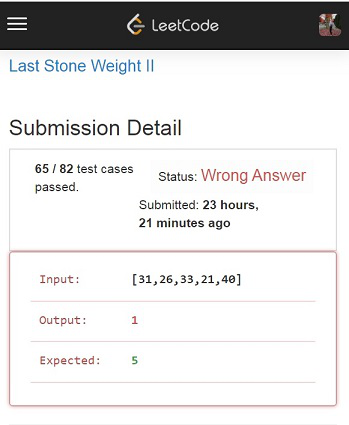
In order to fully understand the algorithm, I asked myself why the second for loop is looping from sum/2 to current variable value, can we do increasing order from current variable value to sum/2 instead. I changed the code, and then one of test cases fails.
I need to look into and be able to explain the above failed test case to change for loop from decreasing order to increasing order. I need to ask a few questions, and work on basics first.
I will come back and update the post based on better understanding of the algorithm.
Follow up on Oct. 9, 2019
I have to answer two questions in my knapsack solution, and argue that why my approach is correct.
Question 1:
The order does not matter. In my C# code, for (int i = 0; i < length; i++) , any order will work. Why?
Question 2:
In my C# code,for (int j = sum / 2; j >= current; j--), why it has to be in descending order in your for loop? Can we use ascending order from current to sum /2.
I think that if I can answer those two questions, I prove that I have a good understanding of my reasoning. Otherwise I just try to pass online judge, I studied the code but I could not figure out the same day.
My argument to answer the question 2 is that every stone can only be used once. So it has to be in descending order, otherwise one stone may be counted more than once to sum value.
My argument to answer the question 1 is hard to describe. I have to prove it using a generic case, give any sum = s1 + s2 + ... + si, each stone in right hand side will be consider once, and then assuming that 1, 2, ..., i is the order to show in the array, and then s1 will be marked true, next s1 + s2, ..., s1 + s2 + ...+si = sum is marked as true. That is all.
I also asked the question in the most popular discussion post
here.
Follow up
Case study
In order to fully understand the algorithm, I asked myself why the second for loop is looping from sum/2 to current variable value, can we do increasing order from current variable value to sum/2 instead. I changed the code, and then one of test cases fails.
for (int j = sum / 2; j >= current; j--) => for (int j = current; j <= sum / 2; j++)
Given the array with values [31, 26, 33, 21, 40], the sum of the array is 151, let us denote it as Sum. Sum/ 2 will be 75. We can divide into two sets, [33, 40] and [31, 26, 21], the sum of first array is 73, and the sum of second array is 78, the minimum difference is 5.
But if we update the loop from ascending, one number may be used more than once, so that minimum difference can be one. Since [26, 26, 23] can be an array, but 26 is counted twice, the sum of the array is 75, so 151 - 2 * 75 = 1.
The following code passes online judge.
public class Solution {
public int LastStoneWeightII(int[] stones)
{
var length = stones.Length;
var sum = stones.Sum();
var found = new bool[sum + 1];
found[0] = true;
for (int i = 0; i < length; i++)
{
var current = stones[i];
for (int j = sum / 2; j >= current; j--)
{
found[j] = found[j] | found[j - current];
}
}
for (int i = sum / 2; i >= 0; i--)
{
if (found[i])
{
return sum - i - i;
}
}
return sum;
}
}