From January 2015, she started to practice leetcode questions; she trains herself to stay focus, develops "muscle" memory when she practices those questions one by one.
2015年初, Julia开始参与做Leetcode, 开通自己第一个博客. 刷Leet code的题目, 她看了很多的代码, 每个人那学一点, 也开通Github, 发表自己的代码, 尝试写自己的一些体会.
She learns from her favorite sports – tennis, 10,000 serves practice builds up good memory for a great serve. Just keep going.
Hard work beats talent when talent fails to work hard.
Figuring out when to let go of a stock can be a tough decision to make, and there are basically two types of selling: Defensive selling to cut your losses, and offensive selling to protect your profits. Let’s take a look at a key offensive sell rule.
Investor’s Business Daily has been helping people invest smarter results by providing exclusive stock lists, investing data, stock market research, education and the latest financial and business news to help investors make more money in the stock market.
keypoints:
Cut loses at7-8%, take your profit at 20-25% benchmark as historically stocks pullback after it reached 20-25%.
Actionable Items
I like to spend time on this channel so that I can improve my English on investing. I do like to be good role model to be a self-learner.
I still remembered the year 1996 when I went to Florida and started my FAU math graduate study. Now it is 25 years ago. I like to write down something called what if I am 25 years old younger.
1996 January to December
I was 30 years old. I do think that it is so easy for me to remember so many things back in 1996. In August, I got the admission from Florida Atlantic University math department with teaching assistant sponsorship.
I have to think about what I should write on this topic. I like to go out to play some tennis, and work on some physical exercise. I need to get some sports activity to help relax and welcome busy Monday.
I will take more time to work on personal finance, health, and sports; I will work on more research how to live a single life, and work on my personality and make myself competitive in terms of things like writing, coding, and other basic skills.
I will work on how to delay gratification, ask questions and try to set goals to work on. When I am young, I do not need so many material things to live on.
It is very helpful for me to make decision to look at one portfolio with all 110 energy sector stocks, so that I can easily tell what to do. The market swing is random, but all of them shows same down trend, I may have to spot the pattern from the portfolio easily by clicking change sorting by losses.
My first portfolio / Energy sector
It took me near one hour to get familiar with those energy stocks.
It is interesting for me to think about how to manage a project with $70,000 Canadian dollars, short term or long term project. If I can make short term profits for 5% to 10%, then the gains will be same as my full time monthly income or more. I should take it seriously and do more research before next Monday. Remember I am a 53 years old, but still a beginner to invest on individual stocks.
Project management
I do think that it is not so easy to save those $70,000 Canada dollars over 10 year full time job. I did not purchase any real estate in Canada after I came to Canada in 2010 April.
I have to take some risk and learn the importance to invest. Focus on long term, not short term result.
Here are ideas to prepare better for this purchase:
Go over all oil stock from fenviz.com, and put together a Yahoo finance portfolio, so I can spot trend of oil stocks in one place;
Evaluate how many more dips after August 21, 2020, should I wait for another 3 to 5% dip?
How to find more oil stocks and then purchase together to add more diversification?
How to take risk if market crashes in next week?
Make plans for long term - 3 to 6 months as oil stock holders.
I do believe that I will have chance to get my capital back if market crashes next week. I need to be patient.
Prepare an Excel sheet for my July 31, 2020 purchase. Work on my last purchase, and find weakness and strength to work on.
Stay confident, and allow myself to make mistakes.
Fenviz -> Screener -> Sector -> Energy -> top 110 stock with capital > 1 Billion
I manually typed those 110 stocks and added those stocks to Yahoo->finance -> portfolio.
Actionable Items
August 24, 2020
Next time make sure to enter all those orders into TFSA. When I tried to place order, the market already went up.
It is better for me to find time and place no pressure, enter those order into Questrade.com, not just Yahoo->Finance-> My portfolio. There is risk and concern every time the project is a big one. If there is no order, then nothing can happen.
It is important to understand myself as a risk taker. I have to make this happen as a beginner. It is best to enter those orders before I go to bed in Sunday night.
I have 170 shares of intel stocks. I like to take some time to learn how Intel works as a business. I like to be a patient investor, do not worry about market value with 5% loss right now.
My study
Here is the article called "Plagued by Chip Delays, Intel Stock Is Almost Cheap Enough to Buy".
My study notes are the following:
below 50 line, price-to-earning of 10 times
Intel has a fair value of $66. It scores a 94/100 on value (based on several metrics, including price-to-earnings and EV/EBITDA).
AMD vs Intel
Intel: plenty of cash on hand and a big marketing budget
AMD: the favored vendor for the do-it-yourself crowd and relies on word of mouth for sales
AMD: growth will require more marketing budget
Forecast
To trade to the $66 – $76 level, Intel will need a few quarters to win back investor trust. It can no longer miss delivering on product milestones. A cyclical downtrend must end, soon.
I purchased 170 shares at price $51.00 dollars, so I may be able to profit 50% return in a few quarters, in other words, less than one year. $4000 US dollars as a beginner. Good job.
Ever since semiconductor chip giant Intel (NASDAQ:INTC) announced yet another delay on its next-generation computer processors, shares traded below the $50 line. Intel stock is still a great value buy, paying a dividend that yields almost 3% and at a price-to-earnings of 10 times, but astute investors are justified in shunning the stock despite favorable valuations.
As long as Advanced Micro Devices (NASDAQ:AMD) takes Intel’s desktop and server market share through Ryzen and EPYC, respectively, Intel looks unattractive. But Intel’s Tiger Lake preview at Architecture Day 2020 gives shareholders hope.
Intel’s Ice Lake chips are 10nm, behind AMD’s 7nm Ryzen 4000 chips. And 7nm CPUs are not ready until 2022 at the earliest. This gives AMD over two years in lead time. How might Intel catch up?
Tiger Lake is Intel’s 11th-generation processor. It uses a new SuperFin transistor, a 10nm solution. Intel claims that a new SuperMIM (metal-insulator-metal) capacitor will give a five-fold increase in capacitance. In real-world terms, it will cut voltage and increase transistor and product performance.
The market’s lack of higher buying in Intel stock in the last week suggests that investors do not care about the development. The stop-gap solutions will not stop AMD from taking its market share.
Still, Intel is the favored chip supplier at retail stores. Lenovo (OTCMKTS:LNVGY), Dell (NYSE:DELL), and HP (NYSE:HPQ) usually feature an Intel-powered laptop or desktop at its online stores.
A Closer Look at INTC Stock
Intel still has plenty of cash on hand and a big marketing budget. Conversely, AMD is the favored vendor for the do-it-yourself crowd and relies on word of mouth for sales. But as AMD’s cash flow grows, its advertising budget will increase. Eventually, AMD advertisements will drive chip sales at a higher pace.
Intel stock has a positive catalyst in the 10-nanometer product is only delayed but not canceled. As it ramps up the product refresh in late 2022 and 2203, it needs to minimize market share loss. It may lower its production costs and tweak its average selling price to remain competitive.
The 14-nanometer product still offers customers decent power draw relative to the CPU’s performance. Attractive prices will deter customers from buying AMD. This will hurt Intel’s profitability in the near-term. Still, by slowing the market share loss, it will buy time. The product schedule slippage is double the previous delay forecast, at four quarters.
Fair Value and Intel Stock
Intel has a fair value of $66. It scores a 94/100 on value (based on several metrics, including price-to-earnings and EV/EBITDA).
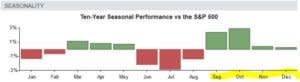
Intel's seasonality starts in Sepember 2020
Source: Chart Courtesy of StockRover.com
Intel stock has a quality score of 99/100, based on metrics like net margin and return on invested capital (according to Stock Rover). Based on its future cash flow discounted to present value, SimplyWall.St thinks that Intel is worth $76.00.
In the seasonality chart below, Intel is about to enter a period of upside starting in Sept.
To trade to the $66 – $76 level, Intel will need a few quarters to win back investor trust. It can no longer miss delivering on product milestones. A cyclical downtrend must end, soon.
Actionable Items
I have to push myself to learn to think long term. One year is reasonable time horizon. I do think that it takes time for me to learn as an investor.
I will spend 10 minutes to read and put together my study notes:
Micron is a leading DRAM and NAND memory manufacturer - leader is a good choice
Major memory device manufacturers in their flash and hard drives -
2017 - 2019, 15% growth in net income
2018 50% growth in revenue and 85% jump in net margins in 2018
2019 - 25% drop in revenue - supply glut, earning margins back to 2017 level
Analysis
making the shift from physical to cloud storage for better and easier accessibility and reliability
Stock will go down $39.00
Micron is a leading DRAM and NAND memory manufacturer, whose products are used by most major memory device manufacturers in their flash and hard drives. Some of the price rise of the last 2 years is justified by the roughly 15% growth seen in Micron’s revenues from 2017 to 2019, which translated into a 25% growth in Net Income. Micron saw a 50% growth in revenue and an 85% jump in net margins in 2018, due to higher selling prices for its latest memory chip technology. However, the semiconductor supply glut in 2019 led to a 25% drop in revenue, and sent earnings margins back to 2017 levels.
Finally, Micron’s Price-to-Earnings (P/E) ratio rose from 9x at the end of 2017 to 9.5x at the end of 2019. The P/E dropped to 3x in 2018 due to a drop in semiconductor and memory demand, but as the supply glut started clearing out and demand started improving, the P/E rose to 9.5x by the end of 2019. While its P/E has dropped to 8x so far this year, given the volatility of the current situation, there is significant possible downside for Micron’s current multiple, especially when compared with previous years: 6x at the end of 2015, and 3x as recently as 2018.
So what’s the likely trigger and timing to this downside?
The global spread of Coronavirus has meant there is much lower demand for computing devices across all markets, which means lower memory device demand, and hence lower demand for Micron’s products. In addition, there have likely been supply disruptions in China and elsewhere from the global Coronavirus crisis. Further, the lockdowns due to Covid have quickened the shift to cloud storage and streaming services, with more and more people making the shift from physical to cloud storage for better and easier accessibility and reliability. This shift will continue hurting demand for Micron’s products in the medium term. We believe Micron’s Q4 results at the end of September will confirm the hit to its revenue. It is also likely to accompany a lower 1H 2021 guidance.
Regardless, if there isn’t clear evidence of containment of the virus anytime soon, we believe the stock will see its P/E decline from the current level of 8x to around 7x, which combined with a reduction in revenues and margins could result in the stock price shrinking to as low as $39.
What if instead you are looking for a more balanced portfolio? Here’s a top quality portfolio to outperform the market, with 170% return since 2016, versus 55% for the S&P 500. Comprised of companies with strong revenue growth, healthy profits, lots of cash, and low risk. It has outperformed the broader market year after year, consistently.
I like to watch the video again before I plan to purchase another over $30,000 Canadian dollar Canadian oil stocks in next dip. I like to figure out what are most common mistakes as a beginner.
15 minutes talk about the book - Trade your way to financial freedom
I purchased 100 shares of WDC on earning day with over 10% losses, but it went down 9.84%. I like to see if I should purchase more shares of WDC. My strategy is to buy weakness and turn into strengths.
They want to preserve liquidity in uncertain times and also pay down the debt faster. Regrettably, they announced all that by conveying the general fact that attention to shareholders is diminished (no divy, no buybacks). This is one of the reasons that this has been declining.
Look at an interesting comparison between two CEOs. One who cares about his shareholders and one who does not: RCL vs. WDC. RCL is in deep debt (twice its equity) and is not doing any business in the foreseeable future. It had a loss much higher than expected. However, during the earnings call he came out and cheered everyone by saying that the bookings for next year are higher. Result: the stock skyrocketed. WDC CEO: they beat expectations, he gave a #$%$ report and went around the channels saying how they have to execute better and how there is significant softness. Result: the stock is down 27% and counting. Who would you want to run your business?
WDC is a solid tech play. Just doesn't know how to communicate with Wall St. Nearly every tech company has lowered guidance. But they communicated well and their stock is up. This obviously is a big problem, but if you have a long term horizon (i.e., retirement account), good time to add. World needs more and more memory, thanks to Youtube, FB, IG and now Tik Tok. WDC is here to stay.
I want to buy but I can't justify it when they don't do anything better than anyone else. Their HDD sales are crushed by Seagate and the SDD market is pretty unsure. On the other hand, this downturn is a good opportunity for them to shift their strategy or innovate.
1. Wealthy traders are patient with winning trades and are enormously impatient with losing trades2.They realize that making money is more important that being right3.They look at charts as a picture of where traders are lining up to buy or sell4.Before they enter any trade they know exactly where they will exit for either a gain or a loss5.They approach trade number 5 with the same mindset they did on the trade 4 previous losing trades6.They use "naked" charts and focus on zones7.They realized a long time ago that being uncomfortable trading is OK8.The markets are their workplace. They are a participant, not an on-looker.9.They stopped trying to pick tops and bottoms.10.They stopped thinking about the market being "cheap" or "expensive"11.They are willing to change sides if the market tells them to do so12.They trade aggressively when trading well and modestly when they are not13.They realize the market will be open again tomorrow14.They never add to a losing trade... EVER15.Cash is the goal, but never the measure of success16.They read about mobs and riots17.They provide liquidity to the markets while watching price and volume18.They have a way to gauge fear, greed and speed of the markets: Tick charts 233, 61219.They practice reading the right side of the chart, not the left20.Every wealthy trader has an "edge" they can explain to their mothers21.Their position size is calculated exactly on risk tolerance22.Profit targets are based on average range or something objective23.One or two trades a month make their month24.Confident decision makers in the face of incomplete information25.A losing trade does not mean they are a loser26.They buy higher highs and sell lower lows27.Their business isn't trading, it's finding the right trades28.They write down or record every trade, price, thoughts, news, attitude29.Their conviction on an active trade remains unless something major changes30.A winning trade does not result in taking on extra risk the next trade31.They trade the reaction, not the news
Actionable items
I like to spend 40 minutes to listen the talk. I want to be wealth trader. My time is from 10:46 am - 11:30 am on August 23, 2020.
There are 4 big mistakes almost every trader makes. Luckily, they can be easily fixed. These mistakes I highlight in this video are probably things you haven't heard before.
Luckily we can flip these points around and come up with a very powerful trading strategy. Charlie Munger once said, "problems frequently become easier to solve if you turn them around in reverse... unless you're more gifted than Einstein, inversion will help you solve problems".
This is what I did in this video. I use inversion to show you exactly why 90% of traders lose money, and how you can capitalize on their mistakes.
Adam Thomas
www.skyviewtrading.com
cut losses
option profits
trading strategy
strategy trader
trading mistakes
biggest mistakes traders make
how to
best trading strategy
option strategy
option trading
options
My notes:
What 90% of traders do:
1. Buy breakouts and sell breakdowns
2. Cut losses short. Let winners run - cool theory but it doesnt work
3. Big position sizes
4. Never cap your profit potential - Higher success rate, smaller profits
Human psychology -
Inversion - your new trade strategy
1. Buy into weakness, sell into strength
2. Book profits, patient with losing trades - winner some point, in the future
3. Small positions - make decision on logic, not emotions
4. Reduce your costs by defined
Actionable Items
I do like to learn step by step to take inversion of 90% of trader doing, buy into weakness, sell into strength.
Aug.21 -- One of the most iconic brands in financial television returns for today's issues and today's world. This week's Wall Street Week features David Westin's interviews with Former Treasury Secretary Lawrence H. Summers, Evercore Co-Chairman & Co-CEO Ralph Schlosstein, Willett Advisors Chairman & CEO Steve Rattner, Former Homeland Security Secretary Jeh Johnson, Former HHS Secretary Kathleen Sebelius, and Former Democratic Presidential Candidate Tom Steyer. The conversations analyze Democratic nominee Joe Biden's economic, tax, health care, climate and foreign policy plans. Mastercard Vice Chairman and Former U.S. Trade Representative Michael Froman talks about what a Biden-Harris administration could mean for U.S. Trade and financial access for under-served communities.
And the company has no intention of resting on its laurels. TC Energy’s mammoth development pipeline has $37 billion of capital projects underway. Around $3 billion of assets have been placed into service in the first half of 2020. These are $2.9 billion of NGTL System and $0.1 billion of Canadian mainline capacity projects.
The company has added $11 billion to its cash position after a sale of 65% equity interest and project financing of the Coastal GasLink project for net proceeds of $2.1 billion. It sold its Ontario natural gas-fired power plants for a total of around $2.8 billion.
TC Energy has also issued debt worth $2 billion (seven-year fixed-rate medium-term notes) and $1.25 billion (10-year fixed-rate senior unsecured notes) and made arrangements for $2 billion worth credit facilities with its bankers.
TC’s construction of the Keystone XL pipeline started in April and has approved a $400 million Elwood Power Project on July 29 to replace, upgrade and modernize certain ANR facilities.
You can take a look at the details of the company’s capital program until 2023.
After seeing the S&P 500 from its March lows, investors should book gains from recent winners and redeploy them in stocks that did not participate in the melt-up.
While the COVID-19 pandemic has disrupted Phillips 66’s operations in the short term, the firm’s available liquidity positions it to weather the downturn.
PSX now trades below its economic book value, or no-growth value, and at its cheapest levels since 2012.
Superior Profitability Helps Grow Market Share During the Crisis and in the Recovery
COVID-19 disruptions to the energy industry already have driven financially weaker operators out of business. Phillips 66’s profitability was superior to its competitors before the crisis, and the firm is well positioned to return to profit growth when the economy recovers.
Per Figure 2, Phillips 66’s net operating profit after-tax (NOPAT) margin improved from 3% in 2015 to 4% TTM. Over the same time, the market-cap-weighted average of Phillips 66’s peer group improved from 2% to 4%. This peer group consists of 17 integrated oil companies, marketers, and independent refiners including Exxon Mobil Corp (XOM), Chevron Corporation (CVX), BP, PLC (BP), Suncor Energy Inc (SU), Marathon Petroleum Corp (MPC), and Valero Energy Corp (VLO) among others[2].
James Beeland Rogers Jr. (born October 19, 1942) is an American investor and financial commentator based in Singapore. Rogers is the Chairman of Beeland Interests, Inc. He was the co-founder of the Quantum Fund and Soros Fund Management. He was also the creator of the Rogers International Commodities Index (RICI).
Rogers does not consider himself a member of any school of economic thought, but has acknowledged that his views best fit the label of the Austrian School of economics.[2][3]
Affordable living within walking distance to Skytrain, shopping, recreation & more. Very open plan gives a spacious and airy feeling. Gas fireplace, new fridge & stove, panoramic views. Rentals ok, Recreation center includes hot tub, exercise room & pool table. Nothing to do here, just move in and enjoy. (id:1937)