From January 2015, she started to practice leetcode questions; she trains herself to stay focus, develops "muscle" memory when she practices those questions one by one.
2015年初, Julia开始参与做Leetcode, 开通自己第一个博客. 刷Leet code的题目, 她看了很多的代码, 每个人那学一点, 也开通Github, 发表自己的代码, 尝试写自己的一些体会.
She learns from her favorite sports – tennis, 10,000 serves practice builds up good memory for a great serve. Just keep going.
Hard work beats talent when talent fails to work hard.
SYDNEY (Reuters) - Asian shares shrugged off caution over the rapidly spreading Delta variant of the coronavirus to advance to one-week highs on Wednesday led by strong U.S. corporate earnings and successful vaccine rollout globally.
In a sign the positive mood will extend overseas, eurostoxx 50 futures added 0.3% while German Dax futures and those for London’s FTSE were up 0.1% each. U.S. futures were slightly weaker with E-minis for the S&P 500 a nudge lower.
Asian markets had started on a jittery note but bounced strongly in mid-morning trades.
MSCI’s broadest index of Asia-Pacific shares outside Japan was last 1.1% up for its third straight day of gains to the highest since July 26.
Japan’s Nikkei was in the red while Chinese shares were quick to turn positive after starting lower. The blue-chip index added 0.7% as did Shanghai’s SSE Composite.
Australian shares were a touch firmer, though sentiment was marred by an unabating rise in Delta infections in Sydney, the country’s biggest city.
Most other Asian indexes were also higher.
Stronger-than-expected profits from U.S. companies in recent weeks have ratcheted up already high Wall Street forecasts on how second-quarter earnings growth will look versus last year.
Close to 90% of companies listed on the S&P500 have reported positive earnings surprises for the second quarter, according to National Australia Bank (NAB) economist Tapas Strickland.
“Our baseline forecast for strong global growth to further gather steam in 2H21 has remained unchanged in recent months,” JPMorgan analysts wrote in a note.
“The central pillar of our global outlook is that vaccines will sever the link between COVID-19 and economic activity,” they added.
“While we expect this process to take place gradually we project progress on this path to be sufficient to unleash significant pent-up demand in 2H21. The growth bounce is already well established in the U.S. and we believe it started in Europe last quarter.”
Investors had been worried about the broader economic outlook with Australia’s largest city in its sixth week of lockdown and other countries battling a spike in infections.
Chinese media have reported 31 provincial regions have warned residents against unnecessary travel in light of recent outbreaks. The mainland reported 96 new cases for Aug. 3, of which 71 were locally transmitted.
“Wuhan has begun city-wide testing in an eerie echo to the original COVID-19 outbreak,” NAB’s Strickland said.
“While China’s resolve to control outbreaks has been well illustrated, markets will continue to watch the outbreak given the high transmissibility of the Delta variant. There are also concerns China’s domestic vaccines are less effective against the Delta variant.”
Wall Street’s main stock indexes were choppy overnight but finished higher with notable gains from Apple Inc, Eli Lilly and Robinhood Markets Inc.
The S&P 500 gained 0.8% to finish at 4,423.15 - another record closing high - while the Dow rose 0.8% and the Nasdaq added 0.6%.
Investors expect volatility to increase in August as more companies report earnings and the market hears from Federal Reserve officials in coming weeks. U.S. non-farm payroll numbers are due on Friday.
The U.S. dollar eased against the Japanese yen and Swiss franc as questions about slowing U.S. economic growth and the Delta variant challenged risk appetite.
The dollar was near a two-month trough against the yen at 109.06. Against the Swiss Franc, the dollar hovered near its lowest since mid-June at $0.9034.
The New Zealand dollar bolted higher after super-strong jobs data cemented expectations for a hike in interest rates this month. The kiwi swung up to $0.7066, a gain of 1% for the week so far.
The risk sensitive Australian dollar was relatively upbeat at $0.7396, but that was largely due to a positive economic assessment by the country’s central bank on Tuesday.
In commodities, Brent futures added 4 cents to $72.45 a barrel. U.S. crude settled down 13 cents at $70.43 a barrel.
Spot gold inched higher to $1,812.8 an ounce.
Reporting by Swati Pandey in Sydney; Editing by Richard Pullin and Sam Holmes
Focus remains on China crackdown, delta strain; crude falls
S&P 500 hit record on earnings; growth risks aid Treasuries
Asian stocks rose Wednesday and U.S. futures were steady as concerns over China’s technology clampdown eased a little and company earnings helped counter worries about the delta strain of Covid-19.
Hong Kong rallied after Chinese state media tempered an attack on gaming companies, bolstering Tencent Holdings Ltd. Shares slipped in Japan, where SoftBank Group Corp. retreated on a potential block of its $40 billion sale of Arm Ltd. to chip company Nvidia Corp. U.S. equity contracts were steady in the wake of a record S&P 500 close on robust earnings. European futures rose.
Investors continue to assess regulatory risks in China as Beijing pushes on with a crackdown on technology giants. Alibaba Group Holding Ltd.’s revenue missed estimates for the first time in over two years, a sign of the clampdown’s toll.
The 10-year U.S. Treasury yield held its retreat, while Japan’s 10-year yield fell to zero for the first time since December.Oilweakened toward $70 a barrel. The delta strain is exacerbating concerns that the rebound from the pandemic is losing steam.
Solid earnings have propelled U.S. and European shares to all-time highs, weathering the spread of the more contagious Covid-19 variant as well as a burst of inflation attributed to pandemic-linked bottlenecks. In comparison, the mood in Asia is more somber amid China’s regulatory broadsides and lagging vaccination rates that are delaying economic reopening across the region.
“We think the delta variant is not going to stop the recovery, it’s just going to delay it,” Laila Pence, Pence Wealth Management president, said on Bloomberg Television. “The Federal Reserve is going to live with a lot more inflation. They don’t want to derail the recovery.”
The delta variant has pushed the threshold for herd immunity to well over 80% and potentially approaching 90%, according to an Infectious Diseases Society of America briefing. Meanwhile, analysts are reviewing economic growth projections for China as officials there grapple with the broadest Covid-19 outbreak since the beginning of the pandemic.
In New Zealand, jobs data strengthened rate-hike bets, bolstering its currency and sapping the 10-year bond.
Key U.S. jobs data due later this week could stoke market swings if they lead investors to adjust expectations over the Federal Reserve’s likely timeline for eventually tapering stimulus. Fed Vice Chair Richard Clarida is due tospeakabout monetary policy Wednesday.
Here are some key events to watch this week:
Treasury quarterly refunding announcement is expected Wednesday
Federal Reserve Vice Chair Richard Clarida due to speak Wednesday
Bank of England is expected to keep its benchmark interest rate and its bond-buying target unchanged Thursday
Reserve Bank of India monetary policy decision, briefing Friday
The U.S. jobs report is expected to show another robust month of hiring Friday
For more market analysis read our MLIV blog.
Stocks
S&P 500 futures were flat as of 7:11 a.m. in London. The S&P 500 rose 0.8%
Nasdaq 100 futures rose 0.1%. The Nasdaq 100 rose 0.7%
Japan’s Topix index fell 0.5%
Australia’s S&P/ASX 200 Index added 0.4%
South Korea’s Kospi index rose 1.3%
Hong Kong’s Hang Seng Index rose 1.1%
China’s Shanghai Composite index increased 0.8%
Euro Stoxx 50 futures rose 0.4%
Currencies
The yen traded at 109.09 per dollar
The offshore yuan rose 0.1% to 6.4582 per dollar
The Bloomberg Dollar Spot Index slipped 0.1%
The euro was little changed at $1.1872
Bonds
The yield on 10-year Treasuries held at about 1.17%
Australia’s 10-year bond yield fell about one basis point to 1.15%
Commodities
West Texas Intermediate crude fell 0.3% to $70.37 a barrel
Gold was at $1,812.47 an ounce, up 0.1%
— With assistance by Vildana Hajric, and Jennifer Bissell-Linsk
strong contract backlog, it expects to generate between $900 million to $1.1 billion of operating cash flow over the next two years
RIG - 1.7 billion of capital spending requirements and $1.5 billion of debt maturing through the end of next year.
Liquidity - burn through
Options: Debt exchanges and new secured financing on some of its vessels
bankruptcy to restructure its liability and gains some more breathing room
Nearly the entire offshore drilling industry filed for bankruptcy last year. One of the few companies left standing is Transocean(NYSE:RIG). However, the company is teetering on the brink, given its near-term financial commitments.
On the one hand, Transocean has $1.7 billion of cash and short-term investments along with $1.3 billion of available credit. Meanwhile, thanks to its strong contract backlog, it expects to generate between $900 million to $1.1 billion of operating cash flow over the next two years. However, Transocean has $1.7 billion of capital spending requirements and $1.5 billion of debt maturing through the end of next year. It's on track to burn through most of its liquidity. While the offshore driller is looking at various options -- like debt exchanges and new secured financing on some of its vessels -- it might have no choice but to file for bankruptcy to restructure its liabilities and gain some more breathing room.
The deep-ocean driller is negotiating with customers and foresees a strong 2022.
What happened
Transocean(NYSE:RIG) stock got a big jolt on the morning of Aug. 3 and tumbled 12% by 10 a.m. EDT. It found some respite as the day progressed, though, and closed the day down only about 3%.
The market dumped shares of the offshore oil and gas drilling services company as it got hold of its second-quarter numbers reported late in the evening of Aug. 2. But investors seem to have spotted a silver lining in the company's outlook.
So what
At a time when pockets of the oil and gas industry are making money off this year's rally in oil prices, Transocean's contract drilling revenue slumped 29.4% year over year and its adjusted net loss ballooned to $109 million from $1 million in Q2 2020. Although consensus estimates called for a loss, the sharp drop in Transocean's revenue caught the market off guard.
To be fair, the offshore drilling market has been stuck in a rut, so Transocean's struggles aren't company-specific. However, Transocean has managed to keep its head above water so far, and investors sent the stock soaring in recent months in anticipation of better days ahead amid the oil market recovery.
Transocean's revival depends a great deal on its backlog and the day rates it charges on rig rentals. Transocean won two contracts in late July, but it's also had to delay the delivery of two drill ships. Importantly, Transocean's backlog was $7.3 billion as of July 21, down both from its $8.9 billion backlog in the corresponding period last year and its $7.4 billion backlog as reported in April 2021. If day rates are low, drillers often end up burning cash instead of building their backlog.
Now what
Although Transocean's numbers leave much to be desired, management hinted at improving customer sentiment during the company's earnings call, and said it was responding to more tenders as well as negotiating directly with customers, particularly in the Gulf of Mexico.
"As we enter the back half of this year, we remain encouraged by the upcycle that is currently unfolding. Assuming oil prices remain supportive, we see utilization and day rates for our ultra-deep water assets materially improving as we move into 2022," CEO Jeremy Thigpen said during the earnings release.
With Transocean also ending the second quarter with a cash and cash equivalents balance of nearly $1 billion, oil and gas investors are hopeful the company will see better days ahead and avoid a much-feared bankruptcy.
Goal: How can we build an ultra-high performance, low-latency storage service for large-scale structured and semi-structured data?
Introduction
Traditional relational databases present a view of multiple tables, each containing rows and named columns. Queries, mostly performed in SQL (Structured Query Language) allow one to extract specific columns from a row where certain conditions are met (e.g., a column has a specific value). Moreover, one can perform queries across multiple tables (this is the “relational” part of a relational database). For example, a table of students may include a student’s name, ID number, and contact information. A table of grades may include a student’s ID number, course number, and grade. We can construct a query that extracts a grades by name by searching for the ID number in the student table and then matching that ID number in the grade table.
With traditional databases, we expect ACID guarantees: that transactions will be atomic, consistent, isolated, and durable. As we saw when we studied distributed transactions, it is not possible to guarantee consistency while providing high availability and network partition tolerance. We often choose to give up consistency in order to ensure high availability and partition tolerance. This makes ACID databases unattractive for highly distributed environments and led to the emergence of alternate data stores that are targeted to high availability and high performance.
Finally, most databases often do not do well with tables containing huge amounts of columns or fields that contain huge amounts of data. Adding additional fields to a column (changing the schema of the database) can be a time-consuming task.
Here, we will look at the structure and capabilities of Bigtable. It is not a relational database; it is just a table but it is designed to work on a huge scale.
Bigtable
Bigtable is a distributed storage system that is structured as a large table: one that may be petabytes in size and distributed among tens of thousands of machines. It is designed for storing items such as billions of URLs, with many versions per page; over 100 TB of satellite image data; hundreds of millions of users; and performing thousands of queries a second.
Bigtable was developed at Google in has been in use since 2005 in dozens of Google services. An open source version, HBase, was created by the Apache project on top of the Hadoop core. Apache Cassandra, first developed at Facebook to power their search engine, is similar to Bigtable with a tunable consistency model and no master (central server).
Bigtable is designed with semi-structured data storage in mind. It is a large map that is indexed by a row key, column key, and a timestamp. Each value within the map is an array of bytes that is interpreted by the application. Every read or write of data to a row is atomic, regardless of how many different columns are read or written within that row.
It is easy enough to picture a simple table. Let us look at a few characteristics of Bigtable:
map
A map is an associative array; a data structure that allows one to look up a value to a corresponding key quickly. Bigtable is a collection of (key, value) pairs where the key identifies a row and the value is the set of columns.
persistant
The data is stored persistently on disk.
distributed
Bigtable’s data is distributed among many independent machines. At Google, Bigtable is built on top of GFS (Google File System). The Apache open source version of Bigtable, HBase, is built on top of HDFS (Hadoop Distributed File System) or Amazon S3. The table is broken up among rows, with groups of adjacent rows managed by a server. A row itself is never distributed.
sparse
The table is sparse, meaning that different rows in a table may use vastly different columns (there could be millions), with many – or even most – of the columns empty for a particular row.
sorted
Most associative arrays are not sorted. A key is hashed to a position in a table. Bigtable sorts its data by keys. This helps keep related data close together, usually on the same machine — assuming that one structures keys in such a way that sorting brings the data together. For example, if domain names are used as keys in a Bigtable, it makes sense to store them in reverse order to ensure that related domains are close together. For example:
	edu.rutgers.cs
	edu.rutgers.nb
	edu.rutgers.www
multidimensional
A table is indexed by rows. Each row contains one or more named column families. Column families are defined when the table is first created. Within a column family, one may have one or more named columns. All data within a column family is usually of the same type. The implementation of Bigtable usually compresses all the columns within a column family together. Columns within a column family can be created on the fly. Rows, column families and columns provide a three-level naming hierarchy to identify data. For example:
To get data from Bigtable, you need to provide a fully-qualified name in the form column-family:column. For example, users:homer or sysinfo:cpu
time-based
Time is another dimension in Bigtable data. Every column family may keep multiple versions of column family data. If an application does not specify a timestamp, it will retrieve the latest version of the column family. Alternatively, it can specify a timestamp and get the latest version that is earlier than or equal to that timestamp.
Columns and column families
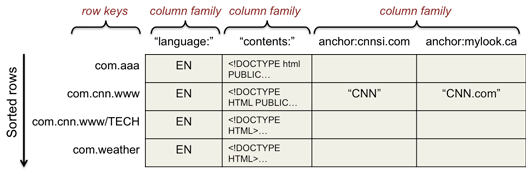
Let’s look at a sample slice of a table that stores web pages (this example is from Google’s paper on Bigtable). The row key is the page URL. For example, com.cnn.www.
Figure 1. Bigtable column families and columns
Various attributes of the page are stored in column families. A contents column family contains page contents (there are no columns within this column family). A language column family contains the language identifier for the page. Finally, an anchor column family contains the text of various anchors from other web pages. The column name is the URL of the page making the reference. These three column families underscore a few points.
A column may be a single short value, as seen in the language column family. This is our classic database view of columns. In Bigtable, however, there is no type associated with the column. It is just a bunch of bytes.
The data in a column family may also be large, as in the contents column family.
The anchor column family illustrates the extra hierarchy created by having columns within a column family. It also illustrates the fact that columns can be created dynamically (one for each external anchor), unlike column families.
Finally, it illustrates the sparse aspect of Bigtable. In this example, the list of columns within the anchor column family will likely vary tremendously for each URL.
In all, we may have a huge number (e.g., hundreds of thousands or millions) of columns but the column family for each row will have only a tiny fraction of them populated. While the number of column families will typically be small in a table (at most hundreds), the number of columns is unlimited.
Rows and partitioning
A table is logically split among rows into multiple subtables called tablets. A tablet is a set of consecutive rows of a table and is the unit of distribution and load balancing within Bigtable. Because the table is always sorted by row, reads of short ranges of rows are efficient: one typically communicates with a small number of machines. Hence, a key to ensuring a high degree of locality is to select row keys properly (as in the earlier example of using domain names in reverse order).
Timestamps
Each column family cell can contain multiple versions of content. For example, in the earlier example, we may have several timestamped versions of page contents associated with a URL. Each version is identified by a 64-bit timestamp that either represents real time or is a value assigned by the client. Reading column data retrieves the most recent version if no timestamp is specified or the latest version that is earlier than a specified timestamp.
A table is configured with per-column-family settings for garbage collection of old versions. A column family can be defined to keep only the latest n versions or to keep only the versions written since some time t.
Implementation
Bigtable comprises a client library (linked with the user’s code), a master server that coordinates activity, and many tablet servers. Tablet servers can be added or removed dynamically.
The master assigns tablets to tablet servers and balances tablet server load. It is also responsible for garbage collection of files in GFS and managing schema changes (table and column family creation).
Each tablet server manages a set of tablets (typically 10–1,000 tablets per server). It handles read/write requests to the tablets it manages and splits tablets when a tablet gets too large. Client data does not move through the master; clients communicate directly with tablet servers for reads/writes. The internal file format for storing data is Google’s SSTable, which is a persistent, ordered, immutable map from keys to values.
Bigtable uses the Google File System (GFS) for storing both data files and logs. A cluster management system contains software for scheduling jobs, monitoring health, and dealing with failures.
Chubby
Chubby is a highly available and persistent distributed lock service that manages leases for resources and stores configuration information. The service runs with five active replicas, one of which is elected as the master to serve requests. A majority must be running for the service to work. It uses a Paxos distributed consensus algorithm to keep the replicas consistently synchronized. Chubby provides a namespace of files & directories. Each file or directory can be used as a lock.
In Bigtable, Chubby is used to:
ensure there is only one active master
store the bootstrap location of Bigtable data
discover tablet servers
store Bigtable schema information
store access control lists
Startup and growth
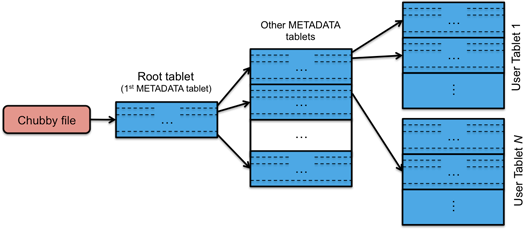
Figure 2. Bigtable indexing hierarchy
A table starts off with just one tablet. As the table grows, it is split into multiple tablets. By default, a table is split at around 100 to 200 MB.
Locating rows within a Bigtable is managed in a three-level hierarchy. The root (top-level) tablet stores the location of all Metadata tablets in a special Metadata tablet. Each Metadata table contains the location of user data tablets. This table is keyed by node IDs and each row identifies a tablet’s table ID and end row. For efficiency, the client library caches tablet locations.
A tablet is assigned to one tablet server at a time. Chubby keeps track of tablet servers. When a tablet server starts, it creates and acquires an exclusive lock on a uniquely-named file in a Chubby servers directory. The master monitors this directory to discover new tablet servers. When the master starts, it:
Grabs a unique master lock in Chubby (to prevent multiple masters from starting)
Scans the servers directory in Chubby to find live tablet servers
Communicates with each tablet server to discover what tablets are assigned to each server
Scans the Metadata table to learn the full set of tablets
Builds a set of unassigned tablet servers, which are eligible for tablet assignment. These will be assigned by choosing a tablet server and sending it a tablet load request.
Fault tolerance and replication
Some of the fault tolerance for Bigtable is provided by Google and Chubby. GFS, for example, provides configurable levels of replication of file data and Chubby’s cell of replicated servers minimizes its downtime.
A master is responsible for detecting when a specific tablet server is not functioning. It does this by asking the tablet server for status of its lock (recall that Chubby grants locks). If the tablet server cannot be reached or has lost its lock, the master attempts to grab that server’s lock. If it succeeds, then it surmises the tablet server is dead or cannot contact Chubby. In this case, the master moves the tablets that were previously assigned to that server into an unassigned state.
When a master’s Chubby lease expires, it kills itself. This does not change the assignment of tablets to servers, however. Google’s cluster management system periodically checks for the liveness of a master. If it detects a non-responding master, it starts one up, which grabs a lock from Chubby. The new master contacts Chubby to find all the live servers goes through the startup phase described earlier.
A Bigtable can be configured for replication onto multiple Bigtable clusters in different data centers to ensure availability. Data propagation is asynchronous and results an eventually consistent model.
References
Fay Chang, Jeffrey Dean, Sanjay Ghemawat, Wilson C. Hsieh, Deborah A. Wallach Mike Burrows, Tushar Chandra, Andrew Fikes, Robert E. Gruber, Bigtable: A Distributed Storage System for Structured Data, Google, Inc. OSDI 2006: The definitive paper on Bigtable