Friday, September 9, 2022

How Many Miles Are Too Many For A Used Car?

How Many Miles Are Too Many For A Used Car?

Dustin Hawley | Apr 18, 2021 

Technological advancements in the automotive industry had led to several improvements to passenger vehicles. Modern powertrains are capable of achieving greater fuel economy while decreasing carbon monoxide emissions. Through active and passive safety systems, passengers are now equipped with an additional layer of protection.

Despite the manufacturer’s effort to create the most durable components, failures are somewhat unavoidable. Mileage can be a strong indicator of the state of the engine, transmission, and suspension. However, with the increase in the number of electronic parts that make up the modern car, determining the mileage limit has become more challenging. 

Maintenance And Owner History - Find the best car deals!

To adequately explain how mileage reflects on a vehicle’s state, we must consider the number of owners and maintenance records. Regular oil changes are crucial for optimal engine performance, followed by oil and air filters. Intervals in which oil needs to be changed will vary depending on the manufacturer. But generally, it’s about 10,000-15,000 miles (or once every year).

Purchasing a new car often includes a 3 to 5-year warranty, which requires the owner to service their vehicle in an authorized shop or dealership regularly. Each service log needs to have a date, current mileage, and the type of service performed, making it easy to verify. Some owners prefer the DIY approach and update the service book themselves, keeping receipts and records archived. 

On the flip side, the risks involved with purchasing a used car are increased with every prior owner. An incomplete service book for a vehicle with numerous previous owners may indicate a hidden problem with the car.

With that said, certified pre-owned cars are an excellent option for prospective buyers. These vehicles are no more than five years old with under 50,000 miles on the odometer, and have been regularly serviced and maintained by the dealership.

Why Is Mileage Important? - Find the best car deals!

The close relationship between the lifespan of moving parts and mileage is the reason why it’s a significant factor in a car purchase. Through regular use, your vehicle’s components naturally wear out and need to be replaced over time.

Though the value of used cars constantly depreciates, spare parts’ value often does not, and the cost of labor also remains the same. The main risk of driving a used car is that at one point, the cost of repairs will likely exceed the car’s remaining value. 

One of the reasons why some drivers prefer older vehicles is because they can be driven almost indefinitely if they are well-maintained. With their robust powertrain and general simplicity, the lack of complex equipment is great for maintenance. But you sacrifice comfort, convenience, and safety features as a result.

How To Pick A Used Car - Find the best car deals!

The age-old adage is that the 100,000-mile mark was indicative of a car past its prime. But despite their complexities, modern vehicles are even more reliable, thanks to a multitude of technological advancements. In general, most modern cars can cross 200,000 miles without any major issues, provided the vehicle is being well-maintained. Considering that an average person drives 10,000-20,000 miles per year, this will account for roughly 15 years of service.

Here are some factors to consider when assessing used car mileage. 

Maintenance Cycles

A harsh reality is that cars are in a constant state of degradation. Through regular service and component replacements, drivers can renew the cycle and keep their vehicles on the road. At their core, engines are built to last for hundreds of thousands of miles, so as long as the components around them are in good condition, the mileage does not necessarily have a profound effect on the car’s viability. 

Timing Belt & Chain

Often overlooked, the timing belt is a crucial element of any working engine, and it needs to be replaced every 60,000-100,000 miles. If it wears out and snaps, it can cause severe damage that could potentially total the entire engine. If you plan on owning the car for several years, consider replacing the belt yourself, or try to find a vehicle that has recently been serviced.

While the timing chain operates in the same way as a timing belt, it usually lasts two to three times longer. Some drivers prefer to never change it, as replacing it could sometimes cost more than selling or trading in the vehicle to purchase a new one. 

Brakes 

Brake pads need to be changed every 30,000 to 70,000 miles, while the discs themselves can last up to 120,000 miles. Fortunately, brake pads are relatively inexpensive to replace, so it’s vital to invest in proper upkeep. 

Uneven and sticky braking or scraping sounds when you engage the brake pedal are common symptoms of worn brakes and can appear suddenly. Often replaced in tandem with the brake pads, be sure to check the service history and condition they’re currently in when assessing a used car.

Transmission

With an average lifespan of 150,000-200,000 miles, the transmission is one of the most crucial and expensive parts to both repair or replace. With regular service, drivers can prolong the life of their transmission, but it is undoubtedly a part you’d never want to replace yourself unless you were a professional. 

Summary - Find the best car deals!

Buying a used car can be a practical investment. New vehicles rapidly depreciate and become available to second-hand buyers at much lower rates. However, you should keep in mind how the car was maintained and the conditions it was driven in whenever you assess a used car’s mileage. 

There’s no absolute number of miles that is too many for a used car. But consider 200,000 as an upper limit, a threshold where even modern cars begin to succumb to the years of wear and tear. The consistency of maintenance and repairs should be your primary concern when determining how many miles may be too much for a used car.

The Fed is ready to charge ahead with higher interest rates

 ECONOMY

The Fed is ready to charge ahead with higher interest rates

Markets are increasingly expecting another supersized hike of three-quarters of a percentage point when Fed officials convene later this month

Expectations are building for another supersized interest rate increase when the Federal Reserve convenes later this month, as central bankers underscore their commitment to controlling inflation — even at the risk of slowing the economy too aggressively and causing a recession.

“It is very much our view, and my view, that we need to act now, forthrightly, strongly, as we have been doing,” Fed Chair Jerome H. Powell said at the Cato Institute’s 40th Annual Monetary Conference on Thursday.

Powell’s remarks were just the latest example of the Fed’s increasingly direct message: The central bank will not stop hiking rates until inflation is under control, no matter what the other consequences are. Powell said the “clock is ticking” to keep inflation expectations in check. Just a day before, Fed Vice Chair Lael Brainard said “we are in this for as long as it takes to get inflation down.”

The pointed tone comes as the Fed is trying not just to control inflation but also to cement credibility with financial markets and American people that it will fix the economy’s biggest problem. The Fed misread warnings last year that inflation was spreading deeper into the economy, and officials have since been in a rush to slow an economy that quickly overheated.

Fed leaders haven’t suggested they’re ready to bring down the pace or scale of their rate hikes yet, and markets are increasingly pricing in another rise of three-quarters of a percentage point at the Sept. 20-21 policy meeting, mirroring the hike in July. Goldman Sachs on Wednesday revised its own forecasts to include a three-quarter-point hike in September, up from expectations for a half a percentage point.

“What I’ve observed from ‘Fed speak’ this week … can be summed up in one word: resolve,” said Joe Brusuelas, chief economist at RSM. “I think there is ample reason why markets are moving to price that in.”

The Fed’s tools to ease inflation’s burden on households and businesses are blunt, revolving around interest rate increases that make lending and investment more expensive. The goal is to cool demand in the economy, especially since the bank can’t do anything to address supply chain problems, Russia’s invasion of Ukraine or other global factors keeping prices high.

Inflation eased a bit in July, thanks to falling gas and energy prices. But officials say they will need months of consistent data to know if their hikes are working. Next week, the Bureau of Labor Statistics will release new inflation data from August.

“Monetary policy will need to be restrictive for some time to provide confidence that inflation is moving down to target,” Brainard said Wednesday in a speech before the Clearing House and Bank Policy Institute’s Annual Conference. “The economic environment is highly uncertain, and the path of policy will be data dependent.”

That uncertainty is global. On Thursday, the European Central Bank raised interest rates for the second time this year, hiking those levels by three-quarters of a percentage point to fight inflation. Officials warned that they expect to continue raising rates over the next few months, all while facing the prospect of a severe energy crisis in Europe this winter.

The Fed has raised rates four times this year and is expected to raise rates at the remaining meetings in September, November and December. Fed officials acknowledge that they don’t know how high rates have to go or how fast to raise them, especially since hikes operate with a lag and will slow economic activity much more later this year or early next year.

“At some point in the tightening cycle, the risks will become more two-sided,” Brainard said, noting that while there are plenty of unknowns, it is also “important to avoid the risk of pulling back too soon.”

Already, the U.S. economy shrank in the first two quarters of 2022, raising fears of a recession and suggesting the economy is already cooling markedly, even while inflation remains high. The slowdown is most evident in sectors that are especially sensitive to interest rates, namely the housing market. Over the past few months, the Fed’s moves triggered a run-up in mortgage rates, culling the buyer pool and putting a damper on the competitive bidding wars and soaring price growth that defined much of the pandemic.

In much of the country, the number of homes listed for sale during the pandemic was low enough that inventory would run out in a matter of weeks if demand stayed constant. Now supply is closer to 11 months. Research from KPMG shows new-homes sales plummeted 12.6 percent in July from the month before, and mortgage applications to purchase a home reached their lowest level since 2016 (excluding the first few weeks of the 2020 pandemic-driven recession).

Housing is often a leading indicator for where the rest of the economy will go, and economists and housing officials are closely tracking it for signs of a more worrisome downturn or a broader recession. But so far, higher rates seem to be having the intended effect of slowing a sector that was churning at unsustainable levels, without causing it to crash altogether, at least so far.

“Home prices are holding steady,” said Brian Bullock, vice president of sales and marketing for Homes by WestBay, a home builder in Tampa. “Overpriced homes are the ones that aren’t selling. … You don’t have the surge of demand from before, where you’d be paying over a rational price for a home.”

Even as some parts of the economy pull back, others are keeping up momentum. Crucially, the job market is still churning and added 315,000 jobs in August alone. A Fed survey known as the “beige book” released Wednesday showed that consumer spending remains strong, even as households grappled with the toll of inflation.

But rates that escalate, and escalate fast, could undermine those bright spots. Speaking to the Financial Times on Tuesday, Richmond Fed President Tom Barkin said he prefers “moving more quickly, rather than more slowly” on raising rates, “as long as you don’t inadvertently break something along the way.”


Tuesday, September 6, 2022

ICDB drive smart book - Chapter 5

Here is the link. 


Apple phone service revenue

Apple released its third-quarter earnings on Thursday and reported $19.6 billion in services revenue, marking a 12% year-over-year increase, but narrowly falling short of Wall Street predictions of about $19.7 billion. The tech giant’s third-quarter services revenue also falls short of last quarter’s record-breaking $19.8 billion and is also down from the 27% growth it reported during the same time period last year.

The category, which includes businesses like the App Store, Apple TV+, Apple Music, cloud services and others — also grew to reach 860 million paid subscriptions on Apple’s platform, which is up from the 825 million it reported in its previous quarter. This figure is up more than 160 million in the last 12 months alone, Apple said.

“The record level of performance of our services portfolio during the June quarter reflects the strength of our ecosystem on many fronts,” Apple CFO Luca Maestri said on the company’s earnings call. “First, our install base has continued to grow, reaching an all time high across each geographic segment and major product category. We also saw increased customer engagement with our services during the quarter our transacting accounts, paid accounts and accounts with paid subscriptions. All grew double digits year over year and paid subscriptions showed very strong growth.”

Maestri also said that the company set all-time records for Apple Music, Apple Care, cloud services and payment services.

The company highlighted a few of its recent achievements in the services category, as Apple CEO Tim Cook outlined that Apple TV+ has now earned 250 wins and 1,110 award nominations and counting. Cook also outlined that this month, Apple TV+ earned 52 Emmy nominations across 13 titles, including “Severance” and “Ted Lasso.”

As for the rest of Apple’s third-quarter results, iPhone revenue was up slightly year over year, from $39.5 billion to $40.7 billion — amounting to a 3% jump from the same time period in 2021. But while the company’s overall picture beat Wall Street expectations, things fared less well across other categories. Mac, iPad and the combined wearables/home category all took a hit for the quarter.


7 lessons on my driving experience - Vancouver - Revelstock - Golden - Lake Louise - Banff - Calgary

Road trip day seven: Lorgan lake to Harrison hot springs, Vancouver - Sept. 3, 2022

Road trip day six: Calgary road trip to Lorgan lake - Sept. 3, 2022

Road trip day five: Banff national park road trip from Calgary - Sept. 2, 2022

Road trip day four: Auto shops - Sept 1, 2022

Road trip day three: Calgary new home -> University of Calgary -> Downtown - August 31, 2022

Road trip day two: Revelstoke -> Lake Louis -> Calgary - August 30, 2022

Sept. 19, 2022

I had a road trip and it was so challenge since I almost became a victim of car accident, and later I got back on BC highway 1, and I had hard time to speed up my car to meet speed limit on busy high way, mountain road. 

The weather was real hot, and I had chance to stop by gas station to have a rest, and then visited Lake Louis visit center. I could not figure out where is lake louis, and then I drove up the mountain twice and got half hour drive on a side road. 

It was so challenge for me to find Lake louise. 


Road trip day one: Vancouver to Revelstoke - August 29, 2022

Linkedin learning: Advanced WordPress: Action and Filter Hooks


Course details

  • 1h 25m
  • Intermediate
  • Released: 7/17/2020
(62)
Action hooks and filters give developers the ability to extend and customize WordPress, the world's most popular content management system. This course teaches you how to write action and filter code to modify WordPress core, themes, and plugins. Instructor Carrie Dils explains how action hooks and filters work and shows how to leverage priorities, arguments, and conditionals for more precise control over when your code executes. Next, learn how to identify the available hooks and filters for different WordPress pages, invoke callback functions, and execute hooks. In the third chapter, Carrie introduces a start-to-finish project where she shows how to build a simple plugin with hooks and filters, and closes with some tips for using third-party developer hooks—and creating your own.

Learning objectives

  • Actions and filters explained
  • Using arguments to pass data
  • Identifying available hooks and filters
  • Looking at load order and dependencies
  • Understanding callback functions
  • Registering and executing hooks in JavaScript
  • Creating a basic WordPress plugin with hooks and filters
  • Adding custom hooks
  • Using third-party hooks

Skills covered


    Leetcode discuss: 94. Binary Tree Inorder Traversal

    Here is the link. 


    C# | Quick learner | Morris traversal | Space optimal: O(1)

    Sept. 6, 2022

    Morris traversal | O(N) time, O(1) space | Space optimal

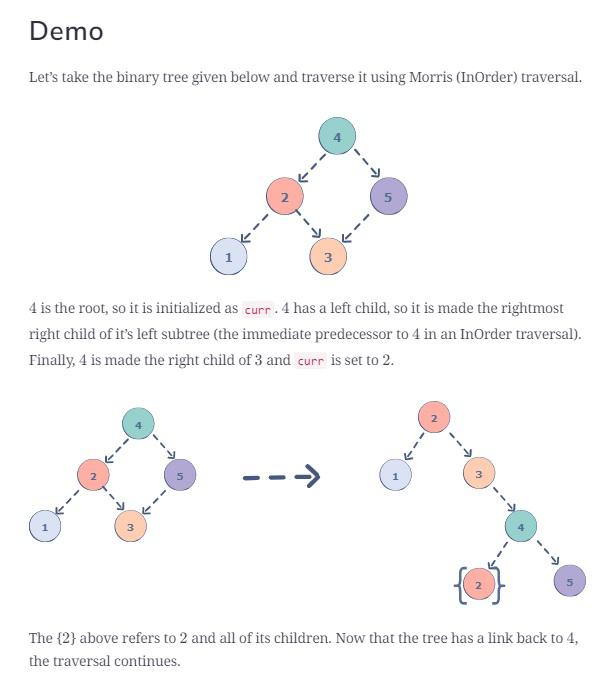
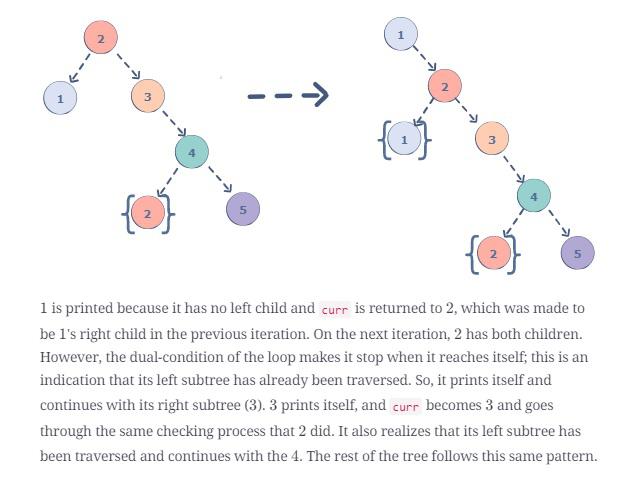
    Morris (InOrder) traversal is a tree traversal algorithm that does not employ the use of recursion or a stack. In this traversal, links are created as successors and nodes are printed using these links. Finally, the changes are reverted back to restore the original tree.

    10 minutes to review the algorithm
    Morris traversal Algorithm

    • Initialize the root as the current node curr.
    • While curr is not NULL, check if curr has a left child.
    • If curr does not have a left child, print curr and update it to point to the node on the right of curr.
    • Else, make curr the right child of the rightmost node in curr's left subtree.
    • Update curr to this left node.

    Illustration | Demo | https://www.educative.io/answers/what-is-morris-traversal
    It is a good investment to spend 10 minutes to go over a demo before spending time to read C# solution.

    image

    image

    Test cases | Debugging | Tree restored | First node 1 in inorder | Second node 2 in inorder
    It is definitely a good exercise to run the debugger, and then track the demo tree first node with value 1 in inorder traversal, and then second node with value 2 in inorder traversal. Rest should be easy. I found out that it is so interesting for me to learn this Morris order traversal with this demo tree.

    The following C# code passes online judge.

    using System;
    using System.Collections.Generic;
    using System.Diagnostics;
    using System.Linq;
    using System.Text;
    using System.Threading.Tasks;
    
    namespace _94_inorder_traversal
    {
        class Program
        {
            public class TreeNode
            {
                public int val;
                public TreeNode left;
                public TreeNode right;
                public TreeNode(int val = 0, TreeNode left = null, TreeNode right = null)
                {
                    this.val = val;
                    this.left = left;
                    this.right = right;
                }
            }
    
            static void Main(string[] args)
            {
                var root = new TreeNode(4);
                root.left = new TreeNode(2);
                root.right = new TreeNode(5);
                root.left.left = new TreeNode(1);
                root.left.right = new TreeNode(3);            
    
                var list = InorderTraversal(root);
                Debug.Assert(string.Join(",", list).CompareTo("1,2,3,4,5") == 0);
            }
    
            /// <summary>
            /// study code
            /// This is C# implementation with Morris In-Order traversal.
            /// Time complexity is O(n)
            /// Space complexity is O(1)
            /// https://leetcode.com/problems/binary-tree-inorder-traversal/discuss/441037/C-Morris-InOrder-Traversal
            /// study Morris traversal
            /// https://www.educative.io/answers/what-is-morris-traversal
            /// Morris (InOrder) traversal is a tree traversal algorithm that does not employ 
            /// the use of recursion or a stack. In this traversal, links are created as successors 
            /// and nodes are printed using these links. Finally, the changes are reverted back to 
            /// restore the original tree.
            /// </summary>
            /// <param name="root"></param>
            /// <returns></returns>
            public static IList<int> InorderTraversal(TreeNode root)
            {           
                var result = new List<int>();
    
                if (root == null)
                {
                    return result;
                }
    
                var current = root;
    
                while (current != null)
                {
                    if (current.left == null)
                    {
                        result.Add(current.val);
                        current = current.right;
                    }
                    else
                    {
                        // make the current node the right child of the rightmost node in curr's left subtree
                        // illustration please the diagram
                        //
                        // find the predec of current
                        var previous = current.left;
                        while (previous.right != null && previous.right != current)
                        {
                            previous = previous.right;
                        }
                    
                        if (previous.right == null)
                        {
                            previous.right = current; // node 3.right = node 4
                            current = current.left; // 
                        }
                        else
                        {
                            previous.right = null;
                            result.Add(current.val); // demo tree - first time, node 2 is node 1's right child
                            current = current.right;
                        }
                    }
                }
            
                return result;
            }
        }
    }


    Wordpress: Plugin Development | Jeff Starr


    Course details

    • 4h 53m
    •    Intermediate
    •     Updated: 8/22/2019
    (143)


    Is your WordPress website missing something special? Almost any feature you can imagine can be built with WordPress plugins. Learn how to build, extend, and distribute your own plugins with these development techniques, featuring the WordPress API and PHP. Learn how to create menus and a settings page, add custom functionality with JavaScript, and style your plugin with CSS. Discover how to customize the WordPress loop, add custom fields and metaboxes, and work with transients, HTTP, WP Cron, AJAX, the REST API, and Gutenberg. Plus, learn how to adjust roles and permissions to keep your plugins secure.

    Learning objectives

    • WordPress APIs
    • Action and filter hooks
    • Activating and deactivating plugins
    • Plugin security
    • Creating the directory and files
    • Adding menus and the settings page
    • Inserting custom functionality
    • Including JavaScript and CSS
    • Testing and debugging WordPress plugins
    • Creating widgets
    • Managing users and roles
    • Adding custom post types and taxonomies
    • Working with custom fields and database queries
    • Using APIs: Transients, HTTP, and REST

    Linkedin learning: Wordpress courses | Annual subscription


    Cancellation


    Oct. 10, 2023
    Renew Linkedin learning 
    $383.00 

    I need to find some courses to study.