Monday, July 29, 2024

Top 4 Smart Money Concept Trading Patterns and Strategies

 Here is the link.

Best 4 Smart Money Concept Trading Strategies in this video we are diving into the top four patterns and trading strategies of smart money concepts, each offering a high probability of success. Recognizing and understanding these 4 specific trading patterns can be a game-changing step in your trading journey but finding these trading patterns requires extensive back-testing and market experience.


Silver Bullet Trading Strategy: Full Tutorial Smart Risk

Here is the link. 

The Silver Bullet trading strategy is one of the best Smart Money trading setups which combines the concepts of liquidity sweep, market structure shift, and fair value gap entry. So, here's what we are covering today. We will provide a step-by-step guide on applying this trading setup to any chart, along with all the mechanical rules that need to be followed. Additionally, we will share practical tips to increase the efficiency of this setup, based on the results of extensive backtesting on the Euro-Dollar currency pair.


Step 2: millstone

  1. Wait for the price to engage the liquidity above the day's high or below the day's low.
  2. Identify a market structure shift to confirm the reversal.
  3. Identify the optimal trading zone (the fair value gap areas)

Best Daily Bias Trading Strategy SMC

In this video, we are going to simplify the concept of the daily bias in smart money trading. Understanding the daily bias will help you increase your win rate by finding better entry setups and having a clearer view of the market's overall conditions.

Get funded with our exclusive code for a 10% discount: Smartrisk10

https://fundednext.com/?fpr=smartrisk If learning advanced trading concepts, Strategies, entry reasons, and how to stay disciplined with a trading plan interests you, then subscribe to our channel and enjoy advanced trading content. Wanna get the faster financial news and real-time market quotes? Go visit: https://www.fastbull.com/aas Download Fastbull: https://www.fastbull.com/aasdownload Backtesting software we use: https://www.traderedge.app/?via=ash __________________________________________________ 00:00 - Introduction 01:09 - Daily Bias Basics 03:58 - Who is in Control? 08:33 - Liquidity 12:16 - Fair Value Gap 14:35 - Chart Example

Best Multi-Time Frame Trading strategy Smart Money Concpets

Here is the link. 

In this video, we are going to show you a trading technique that combines multiple timeframes to get a well-informed trade execution with smart money concepts.


Trading Like the Pros: Smart Money Concept Entry Confirmation Strategies

Here is the link. 

What are the best entry confirmation methods for smart money trading? In this episode, we will guide you through the patterns and methods used by the smart money concept to identify high-probability trades and determine optimal entry and exit points.


3 Best Smart Money Trading Strategy Nobody Talks About!

Here is the link.

Best Setup For Forex Trading In this episode, we're breaking down the key factors and rules to identifying optimal trade setups using the Smart Money concept. Plus, we'll be delving into specific trading scenarios that give SMC traders a clear advantage, taking you one step ahead of the market. So, stick around till the end for some golden insights and strategies to level up your trading game. Let's Get connected: https://linktr.ee/smart_risk Get funded with our exclusive code for a 10% discount: Smartrisk10 https://fundednext.com/?fpr=smartrisk If learning advanced trading concepts, Strategies, entry reasons, and how to stay disciplined with a trading plan interests you, then subscribe to our channel and enjoy advanced trading content. Backtesting software we use: https://www.traderedge.app/?via=ash Videos That you need to watch:    • Ultimate Liquidity Sweep Trading Stra...      • Internal vs External: Decode Liquidit...   __________________________________________________ 00:00 - Introduction 01:25 - Liquidity Types 04:21 - Market Structure Mapping 07:00 - Time Of Trading 09:06 - 1st SMC Optimal Trading Scenario 13:53 - 2nd MC Optimal Trading Scenario 17:15 - 3rd MC Optimal Trading Scenario

Change of Character Simplified - Smart Money Course

Here is the link. 


Liquidity Concepts Simplified | SMC & Price Action

Here is the link. 

In this advanced episode, we’re diving deep into one of the essential concepts in trading: liquidity. We'll also uncover the psychology behind smart money, and reveal the tactics that large financial institutions use to manipulate the market, deceive traders, and set traps. Moreover, we'll unveil practical liquidity patterns that frequently form in the market. patterns that every trader must identify to stay one step ahead of the market. So, make sure you watch this entire video slowly until the end and grab your notepad because we're about to equip you with some invaluable knowledge Let's Get connected: https://linktr.ee/smart_risk If learning advanced trading concepts, Strategies, entry reasons, and how to stay disciplined with a trading plan interests you, then subscribe to our channel and enjoy advanced trading content. Wanna get the faster financial news and real-time market quotes? Go visit https://www.fastbull.com?r=oSBXya Download Fastbull: https://www.fastbull.com/download?r=o... __________________________________________________ 00:00 - Introduction 01:16 - Basics Of Smart Money 02:40 - Dynamic Liquidity 04:40 - Static Liquidity 06:07 - Practical Liquidity Introduction! 07:03 - Equal Lows (Double bottom) 12:34 - Equal Lows (Triple bottom) 13:34 - Equal Highs ( Double bottom & Triple bottom) 15:56 - 2nd Practical Liquidity Pattern type (Trendlines)

David Boies

 David Boies (/bɔɪz/; born March 11, 1941) is an American lawyer and chairman of the law firm Boies Schiller Flexner LLP.[5][6] Boies rose to national prominence for three major cases: leading the U.S. federal government's successful prosecution of Microsoft in United States v. Microsoft Corp., his unsuccessful representation of Democratic presidential candidate Al Gore in Bush v. Gore,[7] and for successful representation of the plaintiff in Hollingsworth v. Perry, which invalidated California Proposition 8 banning same-sex marriage. Boies has also represented various clients in US lawsuits, including Theranos,[8] tobacco companies, Harvey Weinstein, and Jeffrey Epstein's victims including Virginia Roberts Giuffre.

COUR stock | 54% gain after earnings

 What Happened: Shares of online learning platform Coursera (NYSE:COUR) fell 9.7% in the morning session as the stock pulled back, suggesting investors are likely taking profits following its impressive Q2'24 earnings results. The decline also suggests investors are taking a cautious stance and expect more consistent earnings outperformance in the coming quarters.

The stock market overreacts to news, and big price drops can present good opportunities to buy high-quality stocks. Is now the time to buy Coursera? Find out by reading the original article on StockStory, it's free.

What is the market telling us: Coursera's shares are not very volatile than the market average and over the last year have had only 9 moves greater than 5%. In context of that, today's move is indicating the market considers this news meaningful but not something that would fundamentally change its perception of the business.

The previous big move we wrote about was 3 days ago, when the stock gained 54.9% on the news that the company reported second-quarter earnings results. Coursera increased its number of users this quarter. Its revenue and adjusted EBITDA also outperformed Wall Street's estimates. Notably, sales across all major operating segments exceeded Wall Street's estimates, and the company surpassed two million enrollments for its generative AI courses. That the company maintained full-year guidance for revenue, and adjusted EBITDA means it's squarely on track. Overall, this quarter was solid.

Coursera is down 49.9% since the beginning of the year, and at $9.66 per share it is trading 54.1% below its 52-week high of $21.04 from December 2023. Investors who bought $1,000 worth of Coursera's shares at the IPO in March 2021 would now be looking at an investment worth $214.56.

Why You Should Use a Trading Checklist


Why You Should Use a Trading Checklist

Implementing a trading checklist is a vital part of the trading process because it helps traders to stay disciplined, stick to the trading plan, and builds confidence. Maintaining a trading checklist presents traders with a list of questions that traders need to answer before executing trades.

It is important not to confuse a trading plan with the trading checklist. The trading plan deals with the big picture, for example, the market you are trading and the analytical approach you choose to follow. The trading checklist focuses on each individual trade and the conditions that must be met before the trade can be made.

Your Trading Checklist

Before entering a trade, ask yourself the following questions:

  1. Is the market trending or ranging?
  2. Is there a significant level of support or resistance nearby?
  3. Is the trade confirmed by an indicator?
  4. What is the risk to reward ratio?
  5. How much capital am I risking?
  6. Are there any significant economic releases that can impact the trade?
  7. Am I following the trading plan?

1) Is the Market Trending or Ranging?

Trending markets

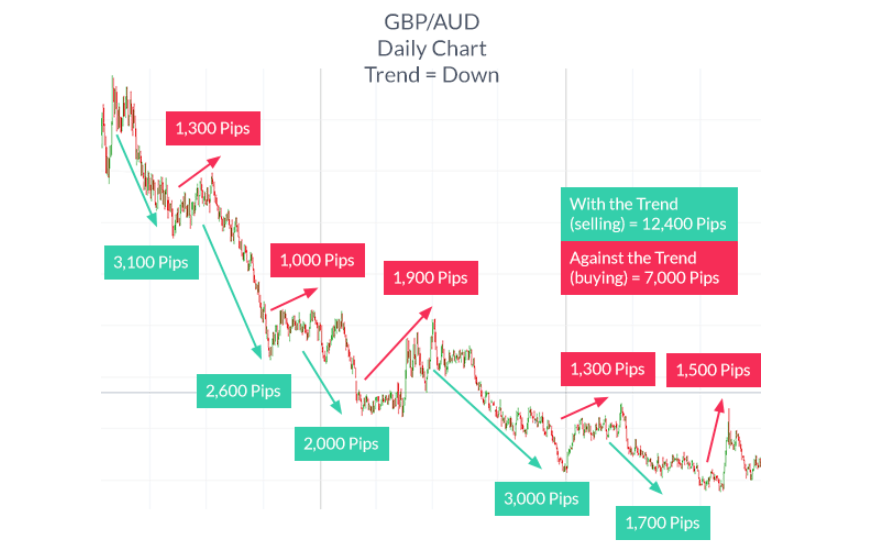
Experienced traders know that finding a strong trend and trading in the trend’s direction, has the potential to lead to higher probability trades.

There is a well-known saying that trending markets have the ability to bail traders out of bad entries. As can be seen below, even if a trader entered a short trade after the trend was well established, the trend would continue to provide more pips to the downside than to the upside.

Traders need to ask themselves if the market is exhibiting signs of a strong trend and whether ‘trend trading’ forms part of the trading plan.

Ranging markets

Ranging markets tend to see price bounce between support and resistance to trade within a channel. Certain markets, like the Asian trading session, tend to trade in ranges. Oscillating indicators (RSI, CCI and Stochastic) can be of great use to traders that focus on range trading.

2) Is there a significant level of support or resistance nearby?

Price action tends to respect certain price levels for a number of reasons and being able to identify these levels is key. Traders do not want to be holding a short position after price has dropped to the key level of support, only to bounce back higher.

The same applies when price approaches a key level of resistance and typically drops lower shortly after. Trend traders typically look for sustained breaks of these levels as an indication that the market may start to trend. Range traders will on the other hand, look for price to bounce between support and resistance for prolonged periods.

3) Is the trade confirmed by an indicator?

Indicators assist traders in confirming high probability trades. Depending on the trading plan and strategy, traders will have one or two indicators that complement the trading strategy. Do not fall into the trap of over-complicating the analysis by adding multiple indicators to a single chart. Keep the analysis clean and simple and easy to view at a glance.

4) What is the risk to reward ratio?

The risk to reward ratio is the ratio of the number of pips that traders will risk in the hopes of reaching the target. According to our Traits of Successful Traders research, which analysed over 30 million live trades, traders with a positive risk to reward ratio were nearly three times more likely to be profitable than those who do not. For example, a 1:2 ratio means that a trader risks half of what he/she stands to gain if the trade works out. The image below further depicts this principle.

5) How much capital am I risking?

It is essential for traders to ask this question. Often traders blow up their accounts by leveraging the account to the maximum when chasing “sure things”. One way to avoid this is to limit the leverage used on all trades to ten to one, or less. Another helpful tip is to set stops on all trades and ensure that the aggregate amount risked is no more then 5% of the account balance.

Before placing a trade, ask yourself, “how much capital should I use?”

6) Are there any significant economic releases that can impact the trade?

Sudden market news has the potential to invalidate the “perfect” trade. While it is almost impossible to anticipate things like, acts of terror, natural disasters or systemic failures in the financial markets, traders can plan for economic releases like NFP, CPI, PMI and GDP releases.

7) Am I following the trading plan?

All of the above is of very little use if it does not tie in with the trading plan. Deviating from the trading plan will result in mixed results and only frustrate the trading process. Keep to the trading plan and do not place trades unless the trading checklist has been completed and confirms the trade may be executed.

Trading Checklists: A Summary

  • Having a trading checklist does not automatically mean all trades will become winning trades. It will however help traders to stick to the trading plan, trade with more consistency, and avoid impulsive or reckless trades.
  • At DailyFX we have dedicated a podcast to the trading plan and how to create one.
  • Document your trades and stay accountable with the help of a trading journal.

Tradingview.com subscription | Starting from July 13 2024

 July 13 tradingview annual subscription $150 US dollars @ Thu Jul 11, 2024

马特洪峰(Matterhorn)游览攻略

 马特洪峰 Matterhorn,最高峰4478米

特殊的三角锥造型,被称为“阿尔卑斯最美山峰”

This new all-in-one indicator

 This new all-in-one indicator includes first of its kind price action methods including Order Blocks w/ volume data, real-time market structure (BOS, CHoCH, EQH/L) w/ 'CHoCH+' being a more confirmed reversal signal, a MTF dashboard, Trend Line Liquidity Zones (real-time), Chart Pattern Liquidity Zones, Liquidity Grabs, and much more detailed customization to get an edge trading price action automatically.

Price action trading is a widely respected method for its simplicity & realistic approach to understanding the market itself. This indicator is an extremely comprehensive approach that opens the possibilities for any trader to automatically display useful metrics for trading price action with enhanced details in each. Get instant access: https://luxalgo.com Join our 100k+ community:   / discord   Full indicator description w/ examples here: https://www.tradingview.com/script/ZG... 0:00 Intro 0:19 Market Structure Diagram 1:59 Advanced Order Blocks + more 3:57 Liquidity & Imbalance Concepts 5:55 Confluence Example 6:41 How to access

Smart Money: What It Means in Investing and Trading


What Is Smart Money?

Smart money is the capital that is being controlled by institutional investors, market mavens, central banks, funds, and other financial professionals. Smart money was originally a gambling term that referred to the wagers made by gamblers with a track record of success.

Key Takeaways

  • Smart money is capital placed in the market by institutional investors, market mavens, central banks, funds, and other financial professionals.
  • Smart money also refers to the force that influences and moves financial markets, often led by the actions of central banks.
  • Smart money is invested on a much larger scale than retail investments.

Understanding Smart Money

Smart money is cash invested or wagered by those considered experienced, well informed, “in the know,” or all three. There is little empirical evidence to support the notion that smart-money investments perform better than non-smart-money investments; however, such influxes of cash influence many speculation methods.

The term “smart money” comes from gamblers who had a deep knowledge of the sport they were betting on or insider knowledge that the public was unable to tap into. The investing world is similar. The populace perceives that the smart money is invested by those with a fuller understanding of the market or information that a regular investor cannot access. As such, the smart money is considered to have a much better chance of success when the trading patterns of institutional investors diverge from retail investors.

Smart money also refers to the collective force of big money that can move markets. In this context, the central bank is the force behind smart money, and individual traders are riding the coattails of the smart money.

In the context of gambling, smart money refers to those who earn a living on their bets; many gamblers use historical mathematical algorithms to decide how much and on what to wager.

Identifying Smart Money

To identify smart money, one should look for the following signs:

  • Large transactions: Smart-money investors often make large, strategic investments in companies that they believe will perform well in the long term. Thus, one should perform some level of volume analysis of securities or the derivatives to determine where the smart money typically is or has recently gone.
  • Insider buying: Insiders such as company executives or board members are considered smart money because they typically would have additional information on the respective company that they are a part of. When these individuals purchase shares of their own company, it can be a sign of confidence in the company’s future prospects.
  • Places with strong growth potential: Smart-money investors often focus on sectors or industries that are expected to experience significant growth in the future, such as technology or healthcare.
  • Long-term investment horizon: Holding onto investments for several years and allowing these investments to grow and mature is typically a sign of smart money.
  • Fundamental analysis: Smart-money investors typically conduct in-depth fundamental analysis, including analyzing financial statements, management teams, and market trends.

Knowing how to spot smart money does not mean one should refrain from conducting their own research and analysis before making any investment decisions.

Tracking Smart Money

There are several ways to track smart money in the financial markets. Some methods include:

  • CFTC filings: The Commodity Futures Trading Commission (CFTC) requires large traders, including institutional investors and hedge funds, to report their positions in futures contracts. These reports, known as Commitments of Traders (COT) reports, can provide valuable information about the trading activities of smart-money investors.
  • Volume analysis: Smart-money investors often make large trades that can be detected by analyzing trading volumes from various securities and derivatives. From this analysis, one can determine whether smart money is buying or selling.
  • Insider trading reports: Insider trading reports can provide valuable information about the transactions of company insiders, which can be a sign of smart-money activity.
  • 13F filings: Institutional investors with more than $100 million in assets under management are required to file a quarterly report called a 13F with the Securities and Exchange Commission (SEC). These reports disclose the institution’s holdings of publicly traded securities, providing insight into the investment strategies of smart-money investors.
  • Hedge fund databases: Hedge funds are considered smart money. There are a number of databases that track the holdings of hedge funds. These databases can be a good source of information about which stocks smart-money investors are trading or investing.
  • News and market sentiment analysis: Smart-money investors often have access to information and resources that allow them to analyze market sentiment and make informed investment decisions. By tracking news and sentiment analysis, investors can get a sense of the direction of the market and whether smart-money investors are bullish or bearish.

The Scale of Smart Money

Investors with large followings, such as Warren Buffett, are considered smart-money investors, but the scale of their activities is not always taken into account. When the cash reserves at Buffett’s company, Berkshire Hathaway, accumulate and are not invested, this is definitely a sign that Buffett does not see many value opportunities in the market. However, Buffett functions on a different scale. A $25,000 investment is not too significant in a billion-dollar portfolio.

Buffett’s smart money acquires companies rather than takes a position. Institutional investors of Buffett’s size need scale for overall portfolio impact. Therefore, even when the smart money is out of value picks in the current market conditions, it does not mean that opportunities—particularly for modestly sized stocks—are absent.

What is the typical transaction size of smart money?

Smart-money transactions can range from tens of millions to hundreds of millions or even billions of dollars. These investors often are able to negotiate favorable terms and access to exclusive investment opportunities due to their size and expertise.

Who is considered smart money?

Institutional investors, hedge funds, private equity firms, high-net-worth individuals (HNWIs), corporate executives, and board members of large companies are all considered smart money.

What are the characteristics of smart money?

Smart-money investors are often highly analytical and research-driven, using a variety of tools and resources to analyze the financial markets and identify investment opportunities. They often have a long-term investment horizon and focus on building portfolios that would generate consistent returns over time. Also, smart-money investors often have a disciplined approach to investing, with a clear investment criteria and a process for evaluating investment opportunities.

The Bottom Line

Smart money refers to investments made by experienced investors, such as institutional investors, hedge funds, or private equity firms, with a proven track record of success in the financial markets. These investors typically have access to significant resources and deep understanding of the markets, and they often focus on sectors or industries with strong growth potential.

To track smart money, investors can analyze data sources such as CFTC filings, volume analysis, insider trading reports, 13F filings, news analysis, and market sentiment analysis. While identifying smart money can provide valuable insights, it is important to conduct thorough research and analysis before making any investment decisions.