Showing posts sorted by relevance for query tears. Sort by date Show all posts

Tuesday, May 15, 2018

Vancouver does not believe in tears

May 15, 2018

Introduction


I like to write a blog called Vancouver does not believe in tears. The story is related to implement the algorithm I was asked in mock interview called swap two nodes in singly linked list. I learned through and after the mock interview on May 15, 2018.

It is a mistake when I write down the test case. I spent time to practice the algorithm called swap kth node with the kth from the end in a singly linked list. Here is C# code.

I made a mistake in my test case, line 37 and line 38 left hand variables are exactly the same, but I tried to find the bug in the algorithm. I spent over one hour and I could explain what kind of bug it was. The behavior was so strange, I used debugger but I could not explain.

My test case is a singly linked list fro 1->2->3->4->5->6, and I like to test the swap 2nd node with 2nd to last end one node. But I made a mistake in test function, the list is created only with 5 nodes, 1->2->3->4->5.

I felt frustrated, and almost exhausted. So I relaxed myself to review one of linked list practices. I came cross one of practice using recursive function. I decided to write a solution based on the recursive function. I found the mistake in test case setup in my code.

How to work with frustration? 


I am so glad to experience the frustration again. I like to measure the level, what kind of actions I have, and later on I can come out good ideas to deal with those kind of mistake.

First let me measure the frustration level, give it rate 7 out of 10. I thought about doing really challenging practice on algorithm, but ended up working on trivial things.

I documented last time I came into tears after the mock interview. After I read the feedback from the interviewer. It is harsh and I Need to learn the lesson of learning harder.


Laundry list of excuses


I like to give possible reasons why I can not handle stress very well in my practice. I can think about several things, first not enough sleep; stress from principal applicant deadline, I need to fill the form for my nephew. And also I do not anticipate anything longer than one hour to write and debug.

In the morning mock interview, I did not simplify the task to swap two nodes's value but instead of working on node reconnects in the singly linked list. Through the mock interview, I learn that I may have done a lot of time at work, I should simplify the task first instead of messing with a complicated problem unnecessary.

I could not believe that I just did very good job for myself last week, and then next week I need to learn from the lesson again. Ask questions about the algorithm, dig deep. Define the requirement, seek the shortcut if there is one. solve the problem quickly first.

Sunday, March 21, 2021

Cystic Fibrosis Nursing | Cystic Fibrosis Symptoms, Causes, Treatment, NCLEX Review

March 21, 2021

Here is the link. 

Cystic fibrosis NCLEX nursing review: Cystic fibrosis is a genetic disorder that causes the exocrine glands to work incorrectly. This can lead to major complications that affect the respiratory, digestive (pancreas, liver, intestines), integumentary, and reproductive systems along with the sinuses. What are exocrine glands? These are glands that produce and transfer it’s secretions (ex: mucous, tears, sweat, digestive enzymes) via DUCTS to it’s intended area of the body rather than directly into the bloodstream like the endocrine glands. In cystic fibrosis, there is a gene that is mutated that prevents the exocrine gland from working properly. It is called the CFTR gene! The CFTR gene, which stands for cystic fibrosis transmembrane regulator, is a protein that controls the channels of sodium and chloride. Hence the sodium and water transport in and out of the cell, and these channels are within the membrane of the cells that makes our sweat, mucous, tears, and digestive enzymes. However, in CF these channels don’t work properly. Therefore, normally these channels would properly regulated sodium and water transport in and out of the cells, which helps control the flow of water within these structures among other things. But this is not what happens in a person with cystic fibrosis. The mucous is thick and sticky rather than thin and slippery. This mucous will block the airways in the lower respiratory system and block the pancreatic duct from delivering pancreatic enzymes. In addition, the sweat glands produce excessive amounts of salt. CF tends to affect Caucasians and males more. The current median life expectancy of a person with cystic fibrosis is 37 years of age (source: NIH.gov). It is currently diagnosed with a sweat test where pilocaprine and electric current is delivered to the skin to make it sweat. The amount of salt in the sweat is measured. Results 60 mmol/L or more is considered positive for CF. Nursing interventions to cystic fibrosis include: chest physiotherapy (chest PT), monitor for complications, educating about PEP devices, preventing infection, administering medications and more (see the video for a detailed review of the nursing interventions)


Sunday, March 31, 2019

Slow to adapt frugality

March 31, 2019

Introduction


It is hard for me to learn to be frugal. I still remembered last Friday we went out for Jenny's last day lunch. I tried to order $3.5 two small pieces desert. "I want to be a frugal person", this is the first time I said that in the party with coworkers.

Open house visit


I also spend a few hours today to visit open house in Surrey near Guildford mall. And this is the first time I thought about frugality. Why do I need to spend my last 10 years savings for a down payment. How can I make a living with over $200,000 debt without any saving left?

I thought about the home costs over $270,000 US dollars for just one bedroom. I prefer to rent and also live closely with others. I should not feel ashamed about living condition. I work hard and that is the best I can get. I still remembered that  I cried when I thought about my finance situation. I should not cry, I make a living and work full time.

I just choose to be happy and then continue to learn other things. I do believe that I have more challenging things to do compared to put myself in a debt. The price is too high and the commute is not practical. Renting business is tough and risky.

I saved $50,000 Canadian dollars in Canada banks working full time last 9 years, I did not learn how to invest on Vanguard total market index fund and then have any capital gain over $30,000 dollars.

The one bedroom owner in 149 st. purchased $160,000 dollars one bedroom in 2016, and started last Sept. to April 2019 to sell from $290,000 dollars, and now lowered to $277,000 dollars.

I do not need to worry about too much owing a home. It is too risky for me, since my asset in Canada is too little to be a home owner. Now the price is so inflated.

Compared to the seller, I learned hard lesson to save those $50,000 Canada dollars. I had to purchase a used car, and replaced the flat tire by myself, and also cut all my expenses from 2017, only food and no other shopping. I have lived in a small room last 10 years.

Actionable Items


It is my thinking process I have to work on. I have to be able to make decision based on frugality principle.

Follow up
Oct. 21, 2020
I just could not believe that I wrote the blog and it brought down my tears. I just could not believe that I have critical thinking and did not go for those inflated condo in the city of Surrey. Now the price went down, and it should go down more. 

Life is tough for an immigrant in Canada. But I do learn things from a stable job, and I think taking more risk in stock market, and focus on long term investment. 


Tuesday, June 25, 2019

Case study: Personal finance education

June 25, 2019

Introduction


I felt so frustrated in Nov. 2018, and I did not know what to do. So I decide to move my research from algorithm and data structure to personal finance research. I like to grow rich and build wealth. I could not believe that I like to study personal finance in the age of 52 years old, first time in my life, I do not want any relatives, friends, I just like to figure out what is going on.  I know that I am running out of time to advance my career, I had two onsite from Amazon in 2016 and 2018. I have to figure out how to grow rich and build wealth.

How to overcome the difficulty?


I live like a teenager, I did not take any risk to purchase a condo when I came to Vancouver in 2010. I had a lot of tears and went over my own personal finance research starting from Dec. 2018 to March 2019; I went over those credit card statements, and then disputed with my siblings from Dec. 2018 to March 2019.

Emotions are biggest enemy for me to build wealth and grow rich.

I wasted net income over $100,000 US dollars back from 1998 to 2001. Because I want all, I want wealth, I want to have relatives in my life, my mom, and friends, I wanted a brand new car Ford Explorer SUV, I wanted so many clothes, travel, stocks, and vacations.

In March 2019, the first time I noticed that I missed 10 year stock market bull market, all more retirement funds and saving are earning less than 2% interest rate.  I found out that I am not financial responsible person from 2010 to 2019. I was so ashamed that I do not study personal finance, I even do not do any book keeping. I was too emotional to live a normal life, fight for opportunity to grow rich and build wealth, no matter how small income I have, no matter if I have permanent residentship in USA or not.

I learn that I was so stubborn and did not take any risk to learn personal finance, learn how to invest on US stock market. All those savings are still the same amount after over two decades.

I invested on stock market, but I did not spend time on the research. I had time from 1998 to 2009 9 years on stock market, but I did not spend 10 hours a month to study stock market, economy, and get into detail, show curiosity in building wealth. And in 2009, I decided to sell every thing and closed stock account and IRA account from Ameritrade.com, since I failed my Canada permanent residentship application.


Wednesday, December 20, 2023

Suits | Donna

 Donna is an excellent networker and was "tied-in" to the gossip and under-belly happenings of Pearson Hardman. Her network is extensive and runs through most of New York City. As a result, Donna is regarded somewhat warily by associates and partners alike. However, she is an excellent confidante and a great people person, which allows her to maintain relationships with people that Harvey cannot. She is social, fun, witty, and charming, and people enjoy interacting with her.

Harvey Specter

Harvey Specter is Donna's longtime boss and close friend. Both trust each other implicitly. They first met at the District Attorney's office, where Harvey was Assistant District Attorney (ADA) and she was his secretary; they have been a team ever since. After working for two years at the DA's office, Harvey took Donna with him to Pearson Hardman.

The two are extremely close. Harvey loves her and trusts her absolutely. He relies upon her and views her as essential to his being. As he told Jessica in "All In," Donna is irreplaceable. Donna, in turn, adores Harvey and is incredibly loyal to him, to the point where she would take a bullet for him. Both tend to view each other as two halves to the same whole, and Donna has put Harvey above all other relationships more than once. They take great pleasure in each other's company and enjoy their jokes and verbal sparring. (They have a pre-trial ritual involving a can opener and thumbtacks.) Over the years, they have developed an ease of comfort found only between best friends, and are very good at reading the other. No one knows Harvey better than Donna, and although Harvey generally tends to keep his feelings close to the chest, he is more open and vulnerable with her than he is with anyone else. She is privy to most of the details of his private life--she knows about Harvey's mother and brother, and is fond of Harvey's father. (She is also the one who informed Harvey of his father's death.) Donna is also one of the few people whose opinion Harvey values, and he listens carefully to anything she tells him, even if he does not always acknowledge it at the time. When upset, Harvey sometimes falls back upon establishing the boss-employee boundary--a boundary Donna is smart enough to know when to ignore, recognizing it for the emotionally distancing tactic that it is. She is likely the only person capable of keeping his reckless tendencies in check. Harvey, meanwhile, is equally good at reading Donna, and although Harvey is not essential for the mechanics of Donna's life, she relies heavily upon his unswerving loyalty, devotion, and emotional support. Despite being protective of his privacy, Harvey has let Donna's parents stay at his condo before (after she cried fake tears--a fact he only finds out later), and Donna has the spare key to his condo.

Donna is a gold mine of information for Harvey and listens in to all his conversations in his office (something Harvey does not discourage, since he leaves his intercom on for her). She is excellent at anticipating his needs, and takes great pride in being able to provide Harvey with what he needs without him asking for it. She views her job as to protect and take care of him, and will go to any lengths to do so. This was first proven in "Rules of the Game", where she gives Jessica incriminating evidence against Cameron Dennis after Dennis threatens Harvey, and again in "Break Point", when she shreds an incriminating memo that she fears will implicate him in a lawsuit.

The events in "Break Point" emotionally strain and confuse their relationship. Travis Tanner resurrects an old lawsuit against Harvey, accusing him of burying evidence and committing fraud. Harvey denies the accusations, stating that he never received the memorandum supposedly in his possession. Donna, however, finds the document in the file room with her date stamp on it. Afraid of the implications against Harvey and seeking to protect him, she hides the truth from him. Harvey nearly commits perjury as a result, and it is only Mike's quick actions that prevent him from doing so. After Mike informs Harvey that Donna found the document, Harvey storms into the ladies' room to confront her. A bitter argument ensues, during which Donna accuses Harvey of keeping things from her and she tells him that she shredded the memo. Feeling furious and betrayed, Harvey tells Donna: "I'm not going to fire you, Donna--I might KILL you--but I'm not going to fire you."

This makes their relationship extremely tense. Both Harvey and Donna are used to being perfectly in sync with each other, and for the first time in a long time, they are out of step. It frightens and confuses Donna that she could have misread the situation (and Harvey) so badly. Harvey, on the other hand, is swamped by his feelings of fury, hurt, and betrayal, and can see little else. He is hurt and upset that she did not trust him enough to come to him with her problems, and a part of him is frightened that she would go to such lengths to protect him. He is afraid that this is something he cannot fix. These are two people who typically know what to do in any situation, and for the first time, both are at a loss. These feelings are further compounded when Jessica fires Donna--Donna feels hurt and betrayed that Harvey didn't fight for her the same way he fought for Mike, while Harvey is uncertain as to how to fight for Donna. His own personal credo of "tough, but fair" creates a conflict within him: on the one hand, he loves Donna and views her as essential to his being; on the other hand, her actions make her termination more than justified. Harvey is at a loss as to what to do, and he is lost without Donna.

While Donna manages to go on with her now Harvey-free life in "All In" and "Sucker Punch", Harvey is incapable of moving on without her. His grief over her departure is so strong that he becomes incredibly reckless, and no one can hold him in check--not even Mike or Jessica. It is only at the end of the episode "Rewind" that Harvey informs Jessica in no uncertain terms that he's bringing Donna back, and it is only in "Asterisk" that the rift between Donna and Harvey is finally mended.

While it is implied late in the first season and throughout the second season that Donna's feelings for Harvey may not be platonic, she informs him in "Asterisk" that she "loves him like a brother or a cousin" and that she is not in love with him. It is unclear if we can take Donna at her word, however, since she is also an excellent actress and has fooled Harvey before.

During the episode "The Other Time" which is referenced in "Asterisk" it becomes clear during flashbacks that Harvey once tried to pursue Donna, but due to her policy of not mixing work with pleasure, she resisted his advances. However when both Donna and Harvey quit the DA's office Harvey visits Donna and she was already waiting for him with a can of whipped cream. Harvey steps into her apartment and she closes the door and he leaned over to kiss her. Although it's not seen, producer Aaron Korsh confimed in an interview that they slept together during this flashback. Afterwards when Harvey gets a new job at then Pearson Hardman, and he asks Donna to work with him to which she agrees on two conditions: a large signing bonus and never to speak of them sleeping together again. The episode also shows where their loose banter and can opener ritual originate from.

At the end of Season 4, after working for nearly 13 years together, Donna quits being Harvey's assistant and is now working for Louis. She decided this because her relationship with Harvey is not working for her. Louis also said to her in a conversation that Harvey is unaware how lucky he is to have Donna. Also Norma, Louis's own assistant, passed away. Before leaving she tells Harvey that she loves him.

After Mike Ross is arrested in the middle of season 5, Louis fires Donna so that she could become Harvey's secretary again and help him help Mike.

Thursday, June 18, 2020

OVV.TO stock: My first purchase of stock in 2020 and first sell as well

June 18, 2020

Introduction

It is my quick decision to sell OVV.TO stocks and I like to write a short blog about my thought process. 

OVV.TO stock 90% price drop

It is the first stock I decided to purchase in 2020. I did purchase 100 shares, but I did not follow up with any more shares and talked and showed off its 300% return in next two months. 

I understood that it is so surprising to learn the lesson from this real experience. I did not learn the passive income, I got into 9 year bull market in 2019 May, and all my positions near $100,000 dollars on SPX 2900 to SPX 3300. But in lowest point SPX 2200 on March 20, I was afraid to purchase stocks. I only purchased $2000 dollars on March 27, 2020. I was scared about a friend gambling comment, hurt me in long run since I took risk to purchase bankruptcy oil stocks on March 27, 2020. 

I remembered that cry and tears I had a few years ago when US government closed the office. I was afraid not to have a job in Canada. 

I had same sufferings as well back this March. Since I learned how to work with my hay fever, coughing, sneezing, and running nose day and night. I was scared by people in the office scared, I took two weeks vacation after March 29, and then one more week vacation after I came back when the stock rebound 100%.

I learned that I did not prepare very well as million USA retail investors do. 

Do not check those professional wealth managers and their opinions. I should care about how tough it is to hold a job in 10 years, and then stress to make a living. 

My purchase and sell 


Wednesday, June 11, 2025

Seven Steps to Prepare Your House as a Rental Property


Seven Steps to Prepare Your House as a Rental Property

A rental property to-do checklist for first-time landlords

The single-family rental market is hot. Realtor.com’s chief economist, Danielle Hale, projects rent price growth will likely remain elevated well into 2023. Based on the consumer price index, the Federal Reserve Bank of Dallas forecasts that year-over-year rental price growth will rise from 5.8%, as of June 2022, to 8.4% as of May 2023.

Many remote employees have moved from where their employer is based but are not ready to sell, if for no other reason than they may have to return to the office someday. Until then, renting their home is a great option to cover a mortgage and earn some passive income.

Preparing a home for rent involves many steps for a successful and legal rental. Hiring a property management company may be your best bet. A full-service residential management firm can prepare your home for rent—market and screen tenants, prepare a lease that protects you, determine and collect rent, manage ongoing maintenance and—when needed—initiate evictions. For those who prefer the do-it-yourself route, here’s a checklist to help you prepare your home to rent.

1. Know the landlord laws in your area.

As a landlord, you must abide by tenant rights laws, local zoning and building codes, and state and federal laws that govern residential property rentals, including adherence to the Fair Housing Act. Your rental application, tenant screening process and rental agreements must comply with these laws. Research the property rental laws in your area and obtain all necessary licenses and inspections before advertising for a tenant.

2. Inspect your property.

Do a top-to-bottom review of your property with a critical eye. New wallpaper or a fresh coat of paint will brighten up a room and give it a fresh new look. Fix anything that needs repair. Check for loose knobs or towel racks, wobbly stair banisters, doors that don’t close properly, tears in screen doors, tiles needing replacing—all the little things you likely no longer notice.

3. Check all appliances and systems.

Engage a certified professional to inspect your home—inside and out. An inspection will uncover issues with household systems and external features, such as the roof, gutters, garage door opener, etc., letting you address the issues that might deter a renter.

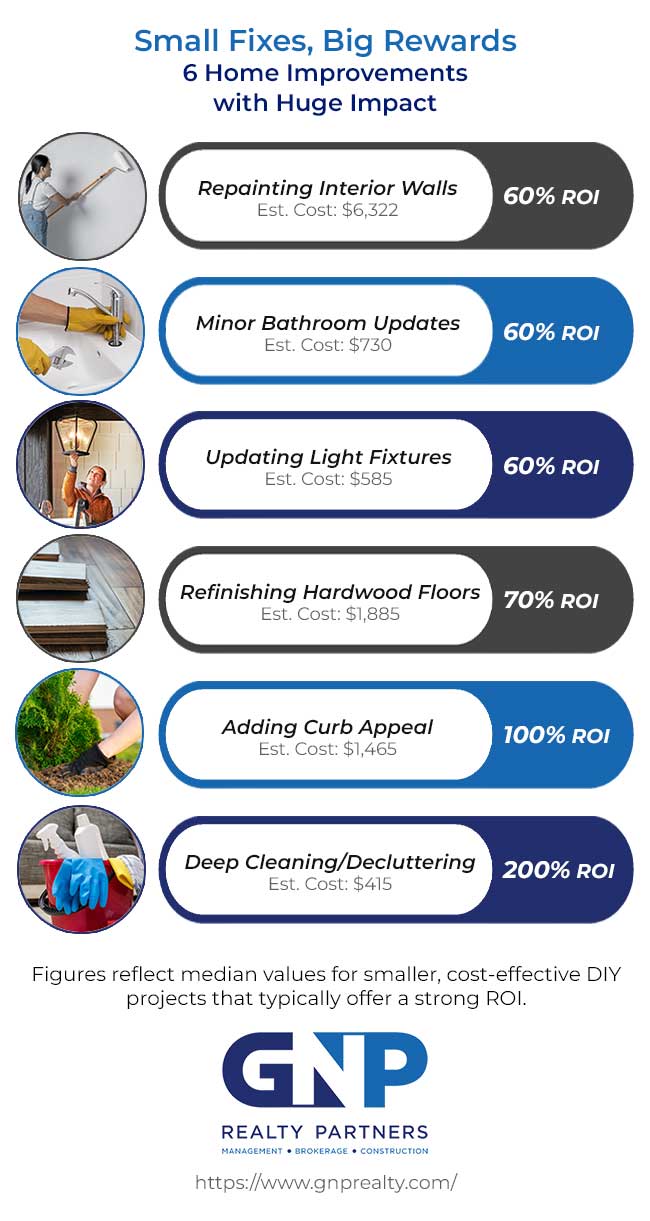
The smaller, DIY home improvement projects outlined below can offer a big return on investment.

6 DIY home improvement projects with big impact infographic

Minus an inspection, hire professionals to check your HVAC and install new filters, the plumbing for any leaks and electrical to confirm all wall switches and outlets are functioning correctly. (Install new light bulbs to brighten up your home.) Also, check that all major appliances are working. Is anything nearing the end of its life cycle? A call from a tenant about a non-functioning refrigerator will never come at a convenient time. Plus, new appliances are a big attraction to renters.

4. Clean, clean, clean.

A dirty home is a huge turnoff to a prospective renter. If you’re a pet owner, remember that not everyone is a fan and won’t appreciate Fido’s hair. Consider hiring a professional cleaner who can undertake deep cleaning—shampoo and steam-clean rugs and hardwood floors—to give your home a fresh look and smell. If you’re not planning to paint, spot clean and wipe down high-traffic areas, e.g., entryways, kitchen backsplashes, etc. Clean windows (inside and out) along with blinds and any draperies.

5. Spray for pests.

The slightest evidence of a pest problem (think mouse droppings, insect carcasses) can be an immediate “no-go” to a prospective renter. If you have a history of insects or rodents in your house (even if limited to the fall after that first cold snap), bring in a pest control company to spray for pests. Consider a contract for periodic treatments to keep tenants happy and your home pest-free.

6. Assess the property for safety concerns and check your insurance.

Ensure you have the required smoke and CO2 detectors. Install fresh batteries. Check to ensure all door and window locks are working. If the home has any structural features that could be hazardous, e.g., a loose stairway handrail, shore up these features to minimize your risk and ensure tenant safety. Talk with an insurance agent about landlord insurance. Your homeowner’s policy is not sufficient if you become a landlord. A good policy will cover property (damage) and liability (if a tenant gets hurt).

7. Remove all clutter and any valuables.

This step applies mainly to those renting their home as a furnished (or partially furnished) property. Decluttering will make your home more appealing to a prospective tenant (who wants to envision it as their home), so remove all personal photos and mementos. Also, remove any furnishing, artwork or contents you’re not willing to have damaged or stolen.

This checklist of steps to prepare your home to rent is not comprehensive, but it’s an excellent place to start—especially if you’re a first-time landlord. While the heavy lifting of preparing your home to rent may be at the front end, there are pros and cons to being a landlord. Consider these carefully and assess your ability and willingness to take on this responsibility.

In today’s hot rental market, you will likely find the cost of hiring a property manager is more than offset by rental income. Further, it will relieve you of the burden of dealing with the issues of having a tenant and a property that needs regular attention. Contact our residential property management team to discuss how we might assist you as a landlord.

Tuesday, October 3, 2023

Rookie Blue Cast Enuka Okuma Has a Million Dollars Bank Balance; Here’s How!

 If you have seen Rookie Blue then you definitely know Traci Nash. Traci Nash was nothing but a character until Enuka Okuma came along. She gave life to the character making it what it was supposed to be. Rookie Blue was definitely her biggest break.

But is that the only role she is known for? Definitely not! Okuma is active in the industry for years or let’s say decades. Throughout the years, she won the hearts of many and at the same time, garnered a net worth that will definitely surprise you. So without wasting any more time, let’s see her net worth and who this beautiful woman is married to.

Decent Bank Balance

Most of the TV actors make an average salary, just enough to lead a normal life; however, Okuma makes way more than an average salary. Over the years, she garnered an estimated net worth of $1 million; but, that is not the total amount of money she earned.

Considering the fact that she made her debut in 1990 and is also a director and a writer, her earning is just a little shy of about $3 million. But, due to her expenses, she is just left with a million dollars in her bank account but, who cares, she is still at the top of her game and surely she will earn much more than that in the coming days.

Appearing in Rookie Blue

The Canadian actress appeared in the first season of Rookie Blue until the final season of the show making her one of the key characters of the show. She got the opportunity to appear alongside some of the renowned faces on television including Missy Peregrym, Ben Bass, and Devon Bostick.

When asked in an interview if she would like to direct an episode of Rookie Blue, she said that she is not ready as the show is big and the cast is famous. She also added that she is writing and would like to direct her own movie.

Movie Themed Wedding

Enuka Okuma is married to her husband Joe Gasparik. They met for the first time in Toronto and became really close friends. At the time they were working together in a crime show. Eventually, they became more than friends and love blossomed between them.

After more than three years of dating, Joe proposed Enuka during a walk on the beach. Okuma was more than happy as tears of joy started pouring out of her heavenly eyes and she agreed.

The duo got engaged and after some years, they exchanged their vows on a magnificent wedding which definitely took after a long time on July 2, 2011. Many of their friends advised them to hire a professional wedding planner but they rather did it themselves. Joe’s parents who are florists assisted them at the wedding and so did Enuka’s sister who is a professional graphic designer.

Their nephews were the ones who carried the rings in a bird’s nest and a ceramic bowl. The wedding reception took place in a theater where many were invited.

One of the things that made the ceremony so movie-themed was the movie posters that hung all over the wall and even at the entrance. The three-course food at the wedding was also delicious followed by the beautiful four-leveled chocolate cake made especially for the wedding. The cake featured subtle change in color from white to sage and the icing all over made it more delicious.

After the wedding, Enuka said that you should enjoy each and every moment of your biggest day. They are still married and have no signs of separation.

Surprising Facts About Enuka Okuma

  • Enuka Okuma voiced Lady Une in Mobile Suit Gundam Wing.
  • Her name in Nigerian gives a beautiful meaning as ‘gift from Heaven’.
  • She is nominated for three Gemini Awards which is the Canadian equivalent of Emmy Award.

Thursday, May 13, 2021

7 KM walk daily | over 200 lb weight control | More reading

 Trying to lose weight when you’re already over 200 pounds is frustrating enough to bring tears. You see a journey you’ve already tried multiple times without success.


IT’S GOING TO TAKE TIME

When you’re 30-50 pounds overweight it’s important to accept the reality of the time investment needed to get the fat off. It took several months, and often years, to accumulate that much excess body fat and it will likely take an equal amount of time to get it off.

When you have a goal in mind, you want it to happen now. You want to see results, now. This impatience works against you, because of the time it takes for your body to adapt to new behavior and diet changes.

It can take 4-6 weeks of specific behavior to notice anything in the mirror. When you’re on a strict diet, exercising five times a week, not seeing results in the mirror can be frustrating enough to quit.

To compensate for this, you should not overburden yourself with new habits that you’re unlikely to continue because it’s too overwhelming. Instead, ease into your new lifestyle changes approaching your diet adjustments in phases.

Allowing each phase to become part of your life and daily routine over several weeks before moving to the next phase will make the transition seamless and less of a shock.

DIET PHASE 1 – HEALTHIER HABITS

Week 1-3:

This phase is all about behavior changes that don’t reduce your total daily calories, or make substantial changes to the foods you normally eat. Think of this phase as “eating healthier”.

You’re not on a diet, and you’re not restricting calories yet. You’re just trying to find all the simple, small changes that put you on the path to a healthier diet.

Examples:

– When you’re eating out, order your food without cheese.
– Skip the mayonnaise on burgers and sandwiches.
– Only use half as much butter as usual.
– Reduce or eliminate the creamer in coffee.
– If you’re a late night snacker, prepare a healthier snack than usual.
– Drink more water
– Exercise once a week

DIET PHASE 2 – DIET CONTENT CHANGES

Week 4-8:

After several weeks of healthier habits, you’re ready to move forward with more significant changes to your diet content. You don’t have to reduce your daily calorie total in this phase, you’re just going to focus on content.

The main staple of a weight loss diet will always be adding lean protein and fiber, while removing simple fast digesting carbohydrates. When you integrate those three factors into every meal, your body will begin to respond and make changes you’re not even aware of.

Protein and fiber will fill you up, making sure you don’t have hunger cravings between meals. Removing simple carbohyrates has multiple benefits to everyone on a diet:

– Sugar spikes insulin, which influences fat storage
– Elevated insulin also negates your ability to feel full

Remove as many fast digesting, sugary foods from your meals as possible. You’ll also want to exercise twice a week for 20-30 minutes each session.

Also: Losing weight over age 40

DIET PHASE 3 – BEGIN CALORIE RESTRICTION

Week 9-Beyond

You’ve made the simple, superficial changes and you’ve even made significant content changes to every meal. This is a good time to begin calorie restriction to start accelerating fat loss over the next few weeks.

Instead of slashing your daily calorie budget to the absolute bare minimum, you should adopt a more progressive restriction. Start by reducing your total daily calories by 200-300.

Your body will adjust, and you’ll soon notice several pounds have melted away over several weeks.

Why You Stop Losing Weight

Your body has an internal calculator of sorts, and has a maintenance calorie range it needs to sustain your current weight.

Example: You weigh 200 pounds and currently eat 3000-3500 calories each day. This is your maintenance range. As long as you consistently eat in this calorie range you will not gain or lose weight.

You decide to start a diet and reduce your calorie range to 2800-3300. Your body will lose a few pounds, and normalize so that 2800-3300 becomes your new maintenance calorie range.

You will maintain that weight, without gaining or losing, as long as you continue to eat 2800-3300 calories each day. You won’t resume your weight loss until you lower your calorie range another 200-300 calories.

The cycle then repeats. Your body will adjust, lose a few pounds, and normalize in the new range. If you want to lose more you will need to re-adjust your daily calorie intake.

During this calorie restriction phase you’ll want to begin exercising three or four times a week. When you combine calorie restriction with consistent cardio exercises every week your fat loss will begin to accelerate exponentially.

Final Thoughts

Trying to lose weight when you’re already over 200 pounds seems overwhelming but it’s not insurmountable. You just have to be smart, and plan your changes.

Set yourself up for success with a calculated progression of changes over several months instead of making too many changes at once that often result in diet failure.

Tuesday, June 1, 2021

Grammarly | 10th anniversary | Machine learning | Startup company | 20 minutes learning of AI and product development

 04-01-19

On its 10th anniversary, Grammarly looks way beyond grammar

The service that began by checking prose for glaring mistakes increasingly wants to help its nearly 20 million daily users do more than simply avoid errors


Plenty of technology companies give away stickers of the sort their fans can slap on the back of a laptop. But the ones available for the taking in the reception area at Grammarly’s San Francisco office are distinctly its own—willfully low-key and thoughtful rather than brash and boastful. (If you know of another tech company that has promoted itself by quoting Anaïs Nin, please let me know.)

Being low-key and thoughtful is a logical tone for a company that is in the business of helping people fine-tune their written words, whether they’re meant for a business document, school paper, or social media post. That is what Grammarly has been doing for a decade, since its founding on April 1, 2009, under its soon-abandoned original name of Sentenceworks. But it’s also how it wants to run its business, which—rather than moving fast and breaking things—waited six years before offering a free version and another two before taking on outside funding.

Like every tech company, Grammarly sees itself as having a higher calling. “It’s important to write well; it’s important to write accurately,” says Brad Hoover, the company’s CEO. “But fundamentally, the problem we’re solving is so much bigger. Communication is something that most of us do from an early age, and it both binds us together as people and tears us apart. And a tool set that helps people bridge those gaps, and connect those dots, and communicate what they mean, really does have the promise to fundamentally change how the world works.”

Grammarly’s aspirations may be lofty, but it’s also adept at the mechanics of building a product and turning a profit. In 2017, General Catalyst managing director Hemant Taneja led the $110 million series A investment round that marked Grammarly’s first intake of outside capital. In recent years, says Taneja, many a startup has claimed to be an AI company simply because it’s trendy. Grammarly, by contrast, “is a business that from the beginning was truly about natural language processing and machine learning. And [it] was working, and it was at scale.”

That scale continues to grow. Grammarly is celebrating its 10th birthday by announcing that it’s on the cusp of reaching 20 million daily active users, including both users of the free version and those who pay $30 a month (or $140 a year) for Grammarly Premium or $15 per user per month for Grammarly Business. That’s up from 15 million last October and just 1 million at the end of 2015, the year it introduced its free version. The company is an uncommonly effective direct marketer; even if you’ve never tried its service yourself, there’s a pretty good chance you’ve been exposed to it on YouTube. And even if you hit the “Skip Ad” button as fast as you could, enough viewers have paid attention that YouTube rated Grammarly’s spot as the most effective “TrueView for Action” ad of 2018, based on reach, clicks, and engagement.

Over the last year or so I’ve tumbled through the Grammarly marketing funnel myself, going from seeing its ads to trying the freebie version to paying for the Premium edition. Now I run some of my Fast Company writings—including this article—through the service. About 40% of its suggestions, I consider but ultimately reject. Another 40% pinpoint weaknesses I already know my writing has, but have failed to eliminate from a first draft. And 20% identify issues I might never have noticed without Grammarly’s assistance.

Now, perhaps you think that I should feel embarrassed admitting I’ve started using Grammarly, given that I’m in my third decade of writing for money—as if I were a pro bicycle racer waxing enthusiastic about my new set of training wheels. But it’s not that it’s transformed my prose. I just find it helpful as a sort of linguistic Jiminy Cricket that watches me at work, steers me in the right direction, and points out when I slip up. Grammarly is only capable of doing that because it’s already gone well beyond its original mission of flagging grammatical and punctuation glitches. And there’s more to come.

IN THE BEGINNING

The Grammarly story begins not in San Francisco but Kiev, the capital of Ukraine, where Max Lytvyn and Alex Shevchenko founded a company called MyDropbox. No relation to Dropbox—which didn’t come along until later—their startup detected plagiarism in academic papers. MyDropbox ended up being acquired by Blackboard, an educational services company; a version is still available under the name SafeAssign.

Lytvyn and Shevchenko’s next idea for a company was inspired by a question left over from their MyDropbox experience: Why do students plagiarize? On a superficial level, at least, the answer was obvious: because effective written communication is hard work. Which led the entrepreneurs to ask themselves another question: Instead of detecting purloined words, why not help people who want to write better?

The notion of using a computer to check grammar was not new. (Old-time wordsmiths will recall Grammatik, a utility that debuted in the 1980s and was folded into WordPerfect in the 1990s.) But Lytvyn, Shevchenko, and Dmytro Lider, another MyDropbox veteran, began their new project in an opportune era. They could check grammar in the cloud—where available computing power is nearly limitless and rules can be updated on the fly—rather than on somebody’s PC. And advances in AI meant that they could analyze text with a new level of sophistication.

Though based in Kiev, the service was about English grammar from the start; to this day, the company has no plans to launch in additional languages. Lytvyn says that the fact its creators learned English as a second language was an asset. “When you communicate in your native language and your native culture, it is easy to assume that everybody around you understands you perfectly,” he explains. “But when you have to do it with a culture and language that aren’t your own, you pay more attention to the challenge.”

At first, the new company’s founders called their service Sentenceworks and aimed it at the education market, which they knew well from their plagiarism checker. (Their new service could scan for uncited use of other people’s words, too, and still does.) Then they emphasized the student audience even more with a new name, EssayRater. It wasn’t until May 2010 that they landed on a moniker that made it clear what the service was about: Grammarly.

Another landmark moment happened later that year when Lytvyn received a call from Hoover, who had spent six years as a venture capitalist for Bay Area-based General Catalyst. “I don’t even know how Brad found my personal phone number, but he called me on my cell phone, completely unexpectedly,” Lytvyn remembers. Hoover, who had been looking for ways to improve his writing and had considered hiring someone to provide advice, had stumbled on Grammarly: “I was blown away by the quality and just instinctively reached out to the founders,” he says.

Hoover “started talking about the product and got so excited about it on the call,” says Lytvyn. “I remember that he said, ‘Oh, I’ll come by next week.'” That was quite a trek—Lytvyn and Shevchenko were based in Toronto at the time.

The three bonded, and Hoover came on board as a consultant. Within a few months, Lytvyn says, it was clear Hoover should be Grammarly’s CEO. Rather than nudging Lytvyn and Shevchenko out of active involvement in the company they’d started, he convinced them that they, and Grammarly headquarters, should relocate to San Francisco. Lider stayed in Kiev; all three founders are still with the company, which now has 120 staffers in Kiev, 70 in San Francisco, and a handful in New York.

THE BOOTSTRAP ROUTE

Despite naming a VC as CEO and putting down stakes in San Francisco, Grammarly did not attempt to morph into a classic venture-funded startup. Instead, it continued to bootstrap itself, offering a paid service rather than pursuing user growth first and figuring out monetization later. From 2010 on, it was cash-flow positive.

Grammarly started with the most basic of interfaces: You pasted your text into a browser-based window, then pressed a button to check it. That was sufficient for its original primary purpose of reviewing student papers, but didn’t exactly encourage users to treat the service as a core part of their writing workflow. Over the years, the company has brought its tools to most of the places people sling words, with browser extensions, Microsoft Office and Google Docs add-ins, and keyboard apps for iOS and Android.

Along the way, Grammarly transcended its academic origins, finding a growing market in users who applied it to personal and professional writings. Indeed, companies were eager to adopt Grammarly before the company was quite ready for them. “We saw somebody buying 5 or 10 Premium accounts within just minutes on the same credit card,” says Lytvyn. “And [our] fraud detection system flagged it as a fraudulent purchase because it didn’t fit the pattern.” It turned out it fit a new pattern: companies rolling out Grammarly to multiple employees, a scenario the company then formalized with a version called Grammarly Business.

As successful as Grammarly was at finding people who were willing to pay for the service, it was obvious that there were even more who might find it valuable but weren’t about to plunk down any money—at least until they’d lived with it for a while. So for several years, the company mulled over the idea of introducing a free version. The move had its risks: Grammarly already had plenty of paying users, some of whom might have opted to downgrade to free accounts.

Moreover, Grammarly didn’t want to do the things that many services do to wring revenue out of non-paying customers. “We felt very strongly about the need to protect our users’ privacy,” says Hoover. “And that’s one of the reasons that we chose to keep that paid subscription model rather than moving to a model where we would have sold or rented user data, which we do not do, or make money off advertising.” (The company’s one brush with privacy-related controversy came last year, when a Google researcher discovered a vulnerability in the company’s browser extensions—quickly patched by Grammarly—which could have leaked text you entered into its online editor.)

In early 2015, Grammarly finally went freemium, introducing a free version with a subset of the 400-plus language checks currently available in the paid incarnation. As it hoped, giving all comers a taste of the service for free resulted in more people choosing to pay for the fuller experience. “Word-of-mouth growth really, really took off,” says Hoover. “That was an inflection point for us.”

Two years later, Grammarly had more than 10 million users and was finally ready to take on outside investment, which came from Hoover’s former firm, General Catalyst as well as IVP and Spark Capital. When Hoover approached General Catalyst to make a pitch for funding, “I had no idea what the founders and Brad had done with the business,” says Taneja. “And that’s when we started talking about what their overall vision was. It was an unusual series A investment for me—I’m usually very focused on early-stage investing. Given all the dialogue we had, I bought into the mission of the company.”

According to Hoover, the funding round was less about the cash—which he says Grammarly didn’t need—than the advice, connections, and raised profile that investors can offer. “A big piece of how we operate here is looking to learn from others and never assuming that we have the answer,” he says. “Being able to talk to others who have been through similar challenges and learn from them—so that we can make new mistakes rather than old mistakes—is really a critical aspect of our success and how we build the organization.”

That organization has been expanding rapidly: The current headcount of 200 is up 40% in a year, with job listings posted for another 37 positions. That’s still far from gigantic—Hoover says that Grammarly could theoretically be a 1,000-person organization if unfettered growth were the goal—but the company will need the additional brainpower to keep its momentum growing. Even if it’s the clear leader in its category, it increasingly competes with two of AI’s dominant forces: Microsoft and Google.

In 2017, Microsoft encroached on Grammarly’s turf by giving Word an AI-powered “Editor” feature that underlines weak or unnecessary words (begone, “maybe” and “really”). Google introduced its own grammar checker for Docs in February. A Word or Docs user who found value in such built-in tools might never get around to investigating Grammarly, though Hoover says that the service is most popular for personal communications—such as email and social media posts—rather than word processing.

Investor Taneja acknowledges the risk of tech giants creating features that make Grammarly feel redundant—but also maintains that Grammarly can do things that functionality built into a particular app cannot. “When you think about all the places that we end up doing written communications now, it’s not just in Microsoft, and it’s not just in Google,” he says. In Grammarly, “you have a cloud-based engine that is getting smarter every time you write, no matter which environment you’re writing in. It naturally lends itself to be an independent, enduring company.”

Taneja may be right. But if some of Grammarly’s existing basics are destined to become commoditized, the company needs new, advanced features that a critical mass of people will pay for. With that in mind, the company has spent the past couple of years developing an AI-infused tone checker, its most dramatic step yet beyond its roots in grammar.

The new feature, Lytvyn says, was inspired by the fact that “emotion and tone are essential parts of communication,” but tougher to master in written form than with spoken words. “At one point, Alex, my cofounder, and I were working on a presentation about our vision for our team,” he recalls. “And to make it more energetic and motivating, we just overloaded it with expletives and high-energy words. But what ended up happening was we just scared the team. Because everybody perceived it as ‘the sky is falling,’ and it was totally not our intention.”

Grammarly has been training its algorithms to identify the flavor of a piece of text, whether it comes off as curious, optimistic, urgent, or concerned. It does so by analyzing words and phrases: A word like “alarming,” for instance, can be . . . well, alarming, while “unexpected” is not freighted with the same tension.

Then again, tension could be what you wish to convey. “This feature is not trying to force a writer to use a specific tone,” says Lytvyn. “It’s more designed to create self-awareness and to help a writer strike the right chord. Sometimes you may want to communicate dissatisfaction and may use this tool to even make it stronger.”

Accurately gauging the tone of a piece of text is a far greater challenge than spotting misplaced commas and passive phrasing. Suggesting revisions to achieve a desired effect is even more ambitious. So Grammarly will implement its new functionality in chunks rather than one big bang. Later this quarter, the company plans to add the ability to assess tone. Eventually, it intends to let Grammarly propose changes. It’s still working on the interface for all this, but it may not look so different from the service in its current form, with squiggly underlines calling your attention to places where it has advice.

If Grammarly can pull off its tone checker in a form that’s useful, it will be quite an accomplishment. Hoover, however, is careful not to sound too giddy. Instead, he’s sticking to the humble, methodical perspective that he says is core to the company’s identity. “Where we’re at, as exciting as it is, is just a starting point,” he says. “We’re a percent of the way to the world’s 2 billion English speakers. We have a very, very long way to go.”