Sunday, July 12, 2020

Dow research: How to place a short term bet on stock?

July 12, 2020

Introduction


It is my idea how to write a short article to show me how to find what stocks to bet on when Dow goes up more than 300 points in one day.

Market research


First, I should spend time to get familiar with yahoo -> Finance -> Dow -> top 30 companies first.

And then I have to review those 30 companies and see which one goes up quickly when market opens.

I also need to figure out if DOW is high position, how much risk it is. It is better to bet on SPX 3000 crash on June 26, compared to July 10 5% return on JPM etc.

If JPM stock goes up, then I should bet on small bank like CIT, and then based on my investment experience related to the stock, invest $5000 or $10,000 dollars, and expect to get 5 to 8% return in one day.

Depending on market overall, I should look into DOW one month range, and then feel comfortable to try 3 days return, 5 days return or one month return instead.

The idea is to take some risk, and then try to get to know business better on this market.


Dow went down lowest on June 26, 2020. I should think about what to purchase on June 26, and then later in a week or two, I can sell them with profit.


Dow research: GS stock

July 12, 2020

Introduction


As an investor, I like to place a bet on short time range, like less than one day. One example is to look into Down top components, over 4% up on July 10, 2020.

GS stock


I like to start to spend time to look into those top companies on DOW, so that I can make a safe bet to get short return in less than a day.

Go to Yahoo finance -> Dow -> Top 30 companies

My task today is to memorize those companies, and spend time to learn about those companies. I like to make bets on short return, if DOW does go up, then I like to quickly look into which company in the list I should look into, place a bet on.


Block Says Chinese Companies 'Don't Play by the Rules'

Here is the link.


Jun.05 -- Carson Block, chief investment officer at Muddy Waters Capital, talks about his views on China with Bloomberg's Erik Schatzker at the Bloomberg Invest Summit in New York.


Watch CNBC's full interview with short-seller Carson Block

Here is the link. 

Luckin Coffee shares have taken a tumble after the company disclosed an executive may have been providing false data. This comes as no surprise to short-seller Carson Block, founder and CIO at Muddy Waters Capital, since he blew the whistle on the company back in January. He joins "Squawk Box" to discuss another company he's calling fraud on. Treasury Secretary Steven Mnuchin told CNBC on Wednesday that small businesses throughout the U.S. should not worry about their odds of receiving relief funding from the federal government. Asked by CNBC’s Jim Cramer about the White House’s work with the Small Business Administration, Mnuchin said he’s confident Congress will approve additional funding on top of the original $350 billion already being distributed. “Jim, we’re raising over $2 trillion for our COVID relief. We’re raising it all across the curve and we have tremendous demand for U.S. Treasurys,” Mnuchin said. “Everybody wants to buy U.S. Treasurys: It’s the safe haven.” “I want to assure all small businesses out there: We will not run out of money. The president has asked us to go back to Congress. We hope they pass this tomorrow or Friday,” he added. “And we want to assure everybody if you don’t get a loan this week, you’ll get a loan next week or the following week. The money will be there.” Congress passed $350 billion in small business funding last month for the Paycheck Protection Program as part of an unprecedented $2 trillion package to try to ease the economic pullback caused by the novel coronavirus and efforts to stanch its spread. But some small business owners worry about being left out of the pot as big banks, equipped with the scope and staff to push the government’s funds out the door, focus on their existing customers. Some, like San Francisco-based Wells Fargo, said Sunday that it likely reached its $10 billion limit based on the applications it had received at the time. The small business measures approved by Congress and President Donald Trump aim to help companies keep employees on the payroll and manage other expenses during the outbreak. Firms with fewer than 500 employees can use the money to cover salary, wages and benefits, with a maximum loan of $10 million. The funding is available through Small Business Administration-approved lenders and loan payments will be deferred for six months with the possibility of forgiveness on at least part of what they borrow.


Carson Block - Muddy water research

Here is the link.


Carson Block is a short-seller and the founder of Muddy Waters Research.[1] Block is known for documenting and alleging fraudulent accounting practices in publicly traded Chinese companies.[2]

Early life and career[edit]

Block grew up in Summit, New Jersey, and holds a law degree from Chicago-Kent College of Law.[3]
Mr Block went to work with his father, a period he describes as “very embittering” as he was “lied to by a parade of management” of internet companies. He quit equity analysis for law school, later moving to Shanghai before leaving law and setting up the self-storage business in 2007.[4]
In 2011, Block was ranked as a 50 Most Influential Thinker by Bloomberg Markets.[5]
In September 2017, Block initiated a private lawsuit against Equifax, accusing the latter of neglecting to safeguard his personally identifiable information.[6] He appears in the documentary The China Hustle, outlining his research into Securities fraud of Chinese companies through Muddy Waters.[7]


Kase Learning to Host Second Shorting Conference

Here is the article.

NEW YORK, Nov. 14, 2018 /PRNewswire-PRWeb/ -- Kase Learning, an investor education company founded by industry veteran Whitney Tilson, is hosting its second Shorting Conference on December 3, 2018, at the New York Athletic Club.
The full-day conference will feature some of the world's top investors who will reveal questionable companies they have identified and share their best, actionable short ideas. Kase Learning's first shorting conference featured renowned short sellers like Carson Block, Ben Axler, David Einhorn and many more, who shared their top ideas.


Tesla Short Sellers are Going Bankrupt

Here is the link.

Three broad reasons:


  1. Messing in booking results
  2. Safety concern
  3. Bet on Elon Musk
Kase learning ......


Market research: Google short sellers of TLSA stock

July 12, 2020

Introduction

As a researcher with limited experience, I like to admit that I am a beginner as an investor. So it is better for me to learn more instead of trying to make profit on my investment. I like to learn more about finance. 

My story

I was too obsessed with market swing, the gain and loss on my portfolio. What I like to do is to learn more about people working on industry. 

Google keyword search: mark spiegel net worth

Tesla Short Sellers Gordon Johnson and Mark Spiegel Take Aim at Elon Musk

Here is the link.

Elon Musk smashed Tesla delivery numbers, but now that the stock has run up, Tesla short sellers Gordon Johnson and Mark Spiegel are back at it again trying to find reasons to short Tesla.


David Einhorn - America investor

Here is the wiki article. 

David M. Einhorn (born November 20, 1968) is an American investor, hedge fund manager, and philanthropist. He is the founder and president of Greenlight Capital, a "long-short value-oriented hedge fund."[2]

Born in New Jersey,[3] Einhorn graduated from Cornell University,[4] before starting Greelight Capital in 1996.[3] Over the next decade, the fund experienced annualized returns of 26%, far better than the market.[3] Greenlight Capital's assets under management has decreased from approximately US$12 billion in 2014 to about $5.5 billion as reported in July 2018 as the fund is down 11.3% from 2014 through the end of 2017, and a further 34% in 2018.[5] He has received extensive coverage in the financial press for his fund's performance, his investing strategy and his positions.[6]

Einhorn was included in Time magazine's Time 100 list of "100 most influential people in the world" in 2013.[7] According to Forbes Magazine, Einhorn has a net worth of US$700 million (as of March 2019), after several years of steep losses for his fund.[1]


Steve Eisman - Betting against subprime

Here is the link. 

Steven Eisman (/ˈaɪsmən/; born July 8, 1962) is an American businessman and investor known for having shorted collateralized debt obligations (CDOs), thereby profiting from the collapse of the US housing bubble in 2007–2008.

Early life, education, and family[edit]

Eisman grew up in New York City, where he attended Yeshiva schools. He attended the University of Pennsylvania, graduating magna cum laude in 1984. [1] He then graduated from Harvard Law School with honors. His parents also worked in finance. They were brokers for Oppenheimer. Eisman was unhappy with his work in law. His parents arranged a position for him at Oppenheimer working as an equity analyst. Oppenheimer's anti-nepotism rules required his parents to pay the first year of his salary.[2][3]


What Ever Happened to Steve Eisman? (He Was Short Tesla, Is Short Canadian Banks)

Here is the link.

Steve Eisman -


Jim Chanos - Short seller

Here is the wiki article. 


Early life and education[edit]

James Steven Chanos was born in 1957 into a Greek immigrant family living in Milwaukee, Wisconsin that operated a chain of dry-cleaning shops.[2] He graduated from Wylie E. Groves High School, and received a B.A. in Economics and Political Science from Yale University in 1980.[3][4]

Personal Life[edit]

Mr. Chanos lives in New York City with his four children. He is currently a lecturer in finance and a Becton Fellow at the Yale School of Management, where he teaches a class on the history of financial fraud.[5] He is also the president of the board of trustees of The Browning School, and serves as a trustee at The Nightingale-Bamford School and The New-York Historical Society.[6]

Career

Tesla Short Sellers Are Running Out Of Excuses

Here is the link.

With Tesla constantly surprising wall street, the Tesla short sellers are running out of excuses. In this video, I unveil the previous Tesla short seller arguments and where the arguments stand as of today.

Short sellers arguments:

TESLA's next decade - Jim Chanos


Tesla's soaring stock: Morgan Stanley's Managing Director Adam Jonas

Here is the link.


Adam Jonas joins CNBC's "Squawk Alley" team to discuss Tesla's storing stock price as the company crosses $900 for the first time. Shares of Tesla are roaring higher — but some are worried Elon Musk’s electric-car maker might be a speculative bubble that sometimes occurs in financial markets, especially near the end of bull markets. Rising more than 110% in 2020 alone, some believe Tesla has become unmoored from its fundamentals, fueled by short covering and the fear of missing out among investors not holding the stock. “Tesla has gone parabolic,” said Matt Maley, chief market strategist at Miller Tabak. “This is taking Tesla well above a level that would be supported by its current fundamentals. … The stock is going to get absolutely clobbered at some point before long.” Tesla shares surged more than 13% on Tuesday, at one point trading above $900 for the first time, and analysts still can’t keep up with the run. The average 12-month price target of analysts is $493, according to FactSet. That new target, which is where analysts expect the stock to be a year from now, is more than 40% below where the stock closed on Tuesday. “When the stock market bubble implodes, it will have been started by the surge in Tesla shares beyond speculative zeal,” former presidential candidate Ralph Nader wrote on Twitter last month amid the run. Flashbacks Some investors are seeing resemblance between the unstoppable enthusiasm over Tesla and the bitcoin bubble a few years ago. After bitcoin’s unprecedented run to nearly $20,000 a piece in 2017, the cryptocurrency crashed a whopping 65% in a span of just one month. By the end of 2018, bitcoin fell below $4,000, an 80% drop from its peak. Others are getting flashbacks to the dot-com bubble in early 2000s, when internet stocks exploded and eventually collapsed, shedding nearly 80% of value within seven months. In December 1999 before the bursting of the tech bubble, Amazon’s valuation hit more than 50 times its IPO price. Right now, Tesla is trading at about 98 times forward earnings, according to FactSet.

Saturday, July 11, 2020

最差财报季重要个股分析

Here is the link.

下个星期,最新或者说最差财报季,就要来了,市场的关注度会随之而来,进行轮换,我会挑一些比较重点的个股给大家做一个分析。


Union find algorithm: Leetcode 305 Island count II

Here is the blog I like to learn from.

Union find - disjoint set

algorithms to review:

  1. Friend Circles
  2. Graph Valid Tree
  3. Redundant Connection II

这种群组类问题,很适合使用联合查找 Union Find 来做,又叫并查集 Disjoint Set,LeetCode 中使用这种解法的题目还不少呢,比如 Friend Circles,Graph Valid Tree,Redundant Connection II 等等。

一般来说,UF 算法的思路是每个个体先初始化为不同的群组,然后遍历有关联的两个个体,如果发现其 getRoot 函数的返回值不同,则手动将二者加入一个群组,然后总群组数自减1。

这里就要分别说一下 root 数组,和 getRoot 函数。两个同群组的个体,通过 getRoot 函数一定会返回相同的值,但是其在 root 数组中的值不一定相同,可以类比成 getRoot 函数返回的是祖先,如果两个人的祖先相同,那么其是属于一个家族的(这里不是指人类共同的祖先哈)。

root 可以用数组或者 HashMap 来表示,如果个体是数字的话,那么数组就 OK,如果个体是字符串的话,可能就需要用 HashMap 了。

root 数组的初始化可以有两种,可以均初始化为 -1,或者都初始化为不同的数字,博主一般喜欢初始化为不同的数字。getRoot 函数的写法也可用递归或者迭代的方式,可参见博主之前的帖子 Redundant Connection II 中的讨论部分

Actionable Items


I also practice more than five implementations of union find algorithms. 

Here is the link. 

Top 10 Algorithms for the Coding Interview (for software engineers)

Here is the link.

1. DFS 2. BFS 3. Matching Parenthesis problem 4. Using Hash Tables 5. Variables/Pointers manipulation 6. reverse linked list (duplicates , removing duplicates) 7. sorting fundamentals (quicksort, mergesort,bubblesort techniques , runtime of a sort,time space complexity) 8. Recursion 9. custom data structures (object oriented programming) 10.Binary search


What’s Next For The U.S. Economy: Gary Shilling

Here is the link.

Financial analyst Gary Shilling says the stock market could be set for a big pullback similar to the decline in the 1930s during the Great Depression. He explains how the coronavirus pandemic will result in long-term structural changes in the economy.


Mock interview: Find third largest maximum number

Here is the link.


Github repository: 100 hard level algorithm repository

July 11, 2020

Introduction


It is so interesting to review my own Leetcode discuss post. I wrote so many of them, now it is time for me to learn from my past experience.

100 hard level algorithm repository


Leetcode 416 and 518, word ladder II algorithm.
DFS algorithm - Find all paths


Google: Coding Interview Prep - How to get in?

Here is the link.


Interview kickstart: How Do FAANG Companies Grade You in Technical Interviews - Soham Mehta - IK UpLevel MicroClass

Here is the link of one hour video.

Given N strings, return groups of anagram

20:00 
Ask clarification questions - what is anagrams?


Enbl stock: Jun 5 2020 to July 11 2020

July 11, 2020

Introduction

It is the challenge to play fear and joy in investment. I should invest more fund when SPX was 2200, but I was afraid and did not learn how to trade often and take some risk. I only purchased around $2500 dollars stock first time over 12 months starting from May 2019. Now I like to write a short case study of ENBL stock.

Case study


Sabr stock: Over $700 dollar loss - June 5 - July 10, 2020

Hi, July 11, 2020

Introduction

It is my short review of Sabr stock positions I have. Right now, I sold all of them, and will consider when to purchase back, what else can I do using those capital for other opportunities.

Case study


Leetcode discuss: 1080 Insufficient Nodes in Root to Leaf Paths

Here is the link.

C# Simple solution using post order traversal

July 11, 2020
  1. Insufficient Nodes in Root to Leaf Paths
Introduction
I only have one week to prepare for Facebook phone screen on July 20, 2020. I found out that I did not learn very well last 12 months on this tree algorithm, first practice was in mock interview on June 8, 2019, but I did not solve the problem; second practice was on July 10, 2020, it took me 85 minutes.
Case study
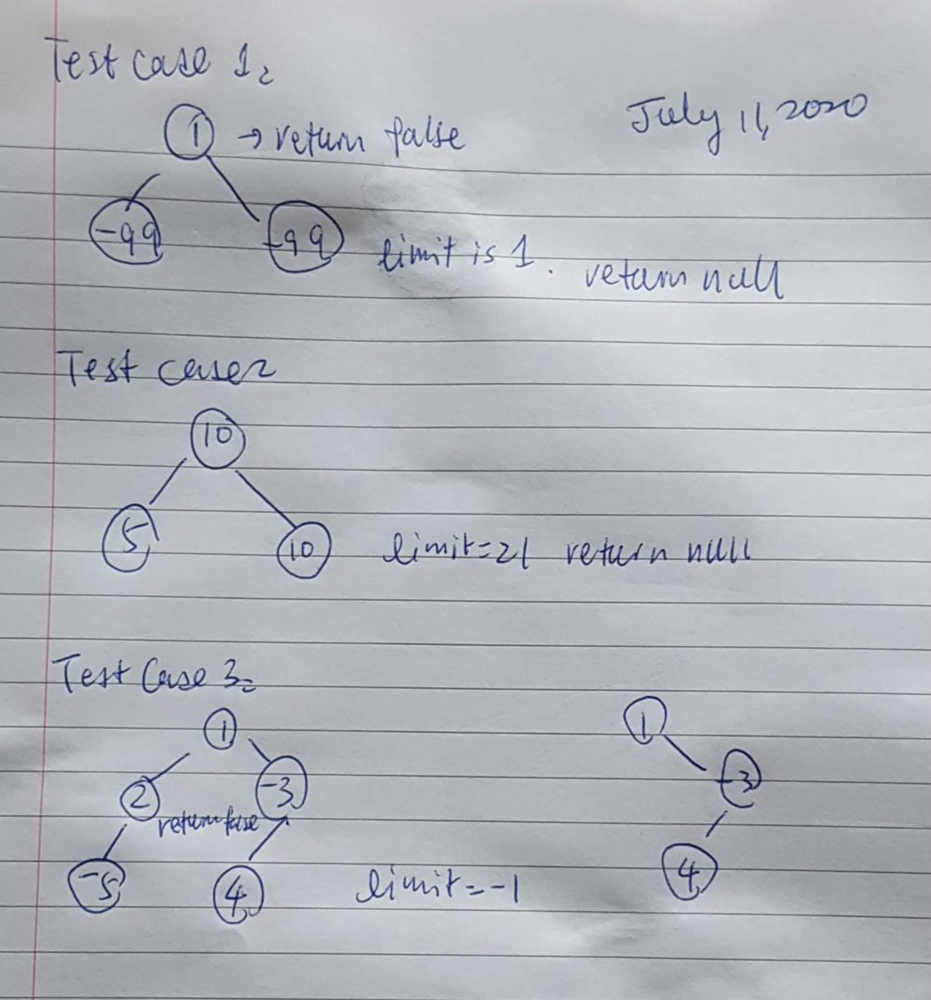
I like to walk through three test cases with the following simple solution, explain to myself how it works.
image
Lower my target when I work on analysis and coding, try to walk through those three test cases, make sure that they all working properly.
Try to simplify the solution, solve it in less than 20 minutes.
Five things - make sure five statements are not missing
  1. root to node p's path sum comparison to limit value - target;
  2. Step 1 more detail, the checking is delayed until the child's recursive call; Leaf node will add its value to sum, and pass the sum to children's recursive call;
  3. Add root node's val to sum variable
  4. Post order traversal - so the node can determine if it should stay or be removed
  5. Remove left child or right child
  6. Return true of false to parent call in call stack
Most challenge - recursive function design - what to return?
The post order traversal return with a bool value, and here are definitions for various cases:
  1. If it is empty left or right child of leaf node, then check sum with root to leaf node path sum;
  2. If it is not a leaf node, then one of chilren has a leaf to survive, return true, otherwise return false;
  3. The node will check it's left and right child return, if left child recursive call returns false, then remove left child, same as right child.
  4. Think about this recursive design using a bool, how many roles it can help to play.
/**
 * Definition for a binary tree node.
 * public class TreeNode {
 *     public int val;
 *     public TreeNode left;
 *     public TreeNode right;
 *     public TreeNode(int val=0, TreeNode left=null, TreeNode right=null) {
 *         this.val = val;
 *         this.left = left;
 *         this.right = right;
 *     }
 * }
 */
public class Solution {
    public TreeNode SufficientSubset(TreeNode root, int limit) {
        if(root == null)
        {
            return null;
        }
        
        if(postOrderTraversal(root,limit,0))
        {
            return root;
        }        
        else
        {
            return null;
        }
    }
    
    /// take some risk
    /// make code simple
    /// if the node is the leaf node of original tree before nodes are removed,
    ///  compare sum with target; only compare when it is leaf node
    /// else 
    ///  post order traversal - a node without any children may not be leaf node
    //   check it's left and right return
    public bool postOrderTraversal(TreeNode node,int target,int sum)
    {
        if(node == null)
        {
            return sum >= target;
        }
        
        sum += node.val;
        
        var left  = postOrderTraversal(node.left, target,sum);
        var right = postOrderTraversal(node.right,target,sum);
        
        if(!left)
        {
            node.left = null;
        }
        
        if(!right)
        {
            node.right = null;
        }
        
        if(node.left == null && node.right == null)
        {
       // test case 1: this applies to three node in the tree, 
    //   bottom up, 
    //   first one: -99 left, second one: -99 right, last one: 1 root
    // test case 3: Only apply to three nodes, node 4 and node -5, node 2
    // leaf node 4, return true & true
    // leaf node -5, return false & false
    // node 2, return false
            return left & right;
        }
        else
        {
      // test case 3: root node 1
            return true;
        }
    }    
}


下周有哪些公司的重磅财报发布

Here is the link.

4:14


CVE.TO stock: June and July 2020 review

July 11, 2020

Introduction

It is tough month for me as an investor in June 2020. I made over $800 gains on CVE.TO stock. 

Case study


Energy stock Cenovus Energy (TSX:CVE)(NYSE:CVE) is also seeing record-low demand for its stock, as investors shun this high-quality company. It trades at a small fraction of its book value, and the popular belief is that it is doomed. But Cenovus is armed with top-quality operations and reserves. It will also remain standing as other competitors go bankrupt.
For its part, Canadian Natural Resources is making long-term plans to cut emissions dramatically over time, and with new technologies, this is possible. Beyond this, Canadian Natural Resources has shown an ability to generate cash flows, even in difficult periods. This should sustain the company until better times come along. This Warren Buffett quote calls for investing in great companies, and Canadian Natural Resources is just that.
As for Cenovus Energy stock, it too can survive the difficulties that plague the oil and gas industry. Before the oil price crash, Cenovus Energy was in a great position. Free cash flow in 2019 was $1.35 billion. The company’s oil sands operations are low cost and top quartile, and it has exposure to refining operations in the U.S.

These 2 Warren Buffett Quotes Apply Perfectly to These 2 Top Energy Stocks

Here is the article.  

Energy stock Canadian Natural Resources (TSX:CNQ)(NYSE:CNQ) is certainly a stock that brings out the fear in most these days. As a result, the stock trades below book value and at a measly three times cash flow. Yes, the oil and gas industry has real issues. Yes, some of those issues are long term in nature. But this top-quality oil and gas company is also unparalleled in its reserve quality, its costs, and its financial strength. While many other oil and gas companies continue to go bankrupt (which reduces production and therefore increases oil and prices), Canadian Natural Resources remains.

Energy stock Cenovus Energy (TSX:CVE)(NYSE:CVE) is also seeing record-low demand for its stock, as investors shun this high-quality company. It trades at a small fraction of its book value, and the popular belief is that it is doomed. But Cenovus is armed with top-quality operations and reserves. It will also remain standing as other competitors go bankrupt.


For its part, Canadian Natural Resources is making long-term plans to cut emissions dramatically over time, and with new technologies, this is possible. Beyond this, Canadian Natural Resources has shown an ability to generate cash flows, even in difficult periods. This should sustain the company until better times come along. This Warren Buffett quote calls for investing in great companies, and Canadian Natural Resources is just that.

As for Cenovus Energy stock, it too can survive the difficulties that plague the oil and gas industry. Before the oil price crash, Cenovus Energy was in a great position. Free cash flow in 2019 was $1.35 billion. The company’s oil sands operations are low cost and top quartile, and it has exposure to refining operations in the U.S.


Most actively traded companies on the TSX

Here is the article.

Baytex Energy Corp. (TSX:BTE). Energy. Up three cents, or 4.48 per cent, to 70 cents on 8.8 million shares. 
The Bank of Nova Scotia (TSX:BNS). Financials. Up $1.41, or 2.6 per cent, to $55.54 on 8.3 million shares.
Enbridge Inc. (TSX:ENB). Energy. Down five cents, or 0.12 per cent, to $40.15 on 8.2 million shares.
The Toronto-Dominion Bank (TSX:TD). Financials. Up $1.18, or 2.01 per cent, to $59.92 on 7.2 million shares.
Algonquin Power & Utilities. (TSX:AQN). Utilities. Up 56 cents, or 3.28 per cent, to $17.62 on 6.3 million shares.
Royal Bank of Canada (TSX:RY). Financials. Up $1.81, or 1.98 per cent, to $93.08 on 6 million shares.


ENB stock: Enbridge (TSX:ENB) Stock Is Ridiculously Cheap!

Here is the article.


Enbridge (TSX:ENB)(NYSE:ENB) was once a dividend darling on the TSX Index. The stock allowed investors to have their cake (a large, growing dividend) and eat it too (steady capital gains) before it turned into an unstable rollercoaster ride in early 2015.

After the latest coronavirus-induced carnage, Enbridge stock now finds itself sporting a gigantic 8% dividend yield. Given the management team that’s willing to swim to great lengths to maintain its reputation as a shareholder-friendly company, the now swollen dividend looks a heck of a lot safer than the company’s financials would suggest.

While Enbridge is a great cash-flow-generative company with decent fundamentals, the company also has a considerable amount of baggage. But this baggage, I believe, is already baked into the share price — and then some. On a price-to-book (P/B) basis, Enbridge stock is close to the cheapest it’s been in recent memory at just 1.35 times book, the lowest it’s been in over a decade.

The company has a considerable amount of total debt ($68.6 billion), but most of it isn’t coming due anytime soon. With a somewhat decent liquidity position (0.6 current ratio) and projects slated to come online over the medium-term, the debt-load shouldn’t be a cause for concern.

But as with most pipeline projects, delays are to be expected along the way. And that’s a significant reason why Enbridge’s future cash flows may be less predictable relative to most other highly regulated utility-like firms.

With Warren Buffett recently betting nearly US$10 billion on the natural gas assets, value investors looking for top-down clues ought to consider a battered pipeline like Enbridge while the midstream world is at its cyclical low point.


HSE.TO stock: I must learn how to catch the rebound

July 11, 2020

Introduction


It is very tough business to invest on stock market as a shareholder of HSE.TO. It is not rocket science. I have to learn and push myself to time the market to catch the rebound of 3.89% percentage on July 11, 2020.

Case study


I can invest on other big oil stock like OVV, CNQ stock instead of HSE. I have $60,000 dollars cash for me to invest on a short term. I should invest $30,000 dollars in one day on July 11, 2020.


I have loss on July 9 607.50 + 321.60 = over 928 dollars, over 10% loss. 

Rule no 1: invest at least $20,000 or $30,000 dollars when the loss is over 10% in less than 3 business day. Try to catch a rebound over 4% on a stock on TSE. 

July 11, 2020 HSE.TO has over +3.89% rebound. I should expect a lot of stocks having same rebound on July 11, 2020. 

For example, Canadian banks, oil stock, and others.