Sunday, May 16, 2021

Facebook behavior interview: Leetcode discuss | anonymous sharing

May 16, 2021

Here is the link of original post on Leetcode.com. Here is the link of 20 minutes video. 

Prepare for Facebook Behavioral Interview (Jedi Round)

143
Anonymous User

Note: Don't forget to upvote if you find the post helpful! Thanks for reading!

Hi Everyone, in this article, I have summarized some of the frequent Facebook Behavioral Interview Questions. I hope you find them helpful in your interview preparation.

What is the Behavioral Interview Round at Facebook?

  1. Behavioral Interview Round is also known as the Jedi Interview round at Facebook.
  2. It is about you and your history, your résumé, and your motivation.
  3. The purpose of this interview is to assess whether the candidate will thrive in Facebook's peer-to-peer, minimal process, and unstructured engineering organization.

Note: For Software Engineers, the behavioral interview is actually part behavioral and part coding. The coding part is a shorter version of the usual coding interviews and is included to supplement the other two coding interviews to get an additional coding signal.

Preparation Tips & Tricks

image

  1. Know yourself! Take the time to review your résumé, as the interviewer will almost certainly ask about key events in your work history.
  2. Have concrete examples or anecdotes to support each of the questions.
  3. Familiarize yourself with Facebook's mission statement and its five core values:
    • Be Bold
    • Focus on Impact
    • Move Fast
    • Be Open
    • Build Social Value
  4. Be yourself! Be open and honest about your successes and failures.
  5. Be humble and focus on teamwork, leadership, and mentorship qualities.

Now let us review the top behavioral questions which are usually asked at Facebook.


Question 1: Tell me about a time you disagreed with someone

Tell me about a time you disagreed with someone is one of the most frequent questions asked in behavioral interviews.

Interviewers also tend to ask this famous question in the following ways:

  • Tell me about a time you had a conflict with your manager.
  • Share a situation where you faced a conflict at work.
  • Have you ever worked with a difficult person?
  • Describe a situation where two teams disagreed on a path forward.
  • Tell me about a time you had a communication problem with a coworker.

Evaluation Criteria

image

Having conflicts is a part of everyone's career journey. By this question, the interviewer is trying to evaluate you on the following:

  1. Assess how you work in difficult situations or unstructured environments.
  2. Judge your maturity level, communication skills, and willingness to speak up irrespective of your coworker's seniority.
  3. Evaluate whether you are empathetic and respectful towards your colleagues while trying to understand your coworker's motivations and viewpoints behind the conflict.
  4. A crucial element to this question is that the interviewer is looking for a positive resolution of the conflict that benefits the company and not just an individual.
  5. Interviewers are trying to see if you are flexible to compromise.
  6. And open to learning from challenging experiences.

Question 2: Tell me about a time you showed leadership

Candidates often get asked in the behavior interviews to tell about a time when they showed leadership in their workplace.

Evaluation Criteria

image

By this question, the interviewers are looking to evaluate you on various attributes like:

  • Taking responsibility
  • Having confidence
  • Strong communication skills
  • Relationship-building skills

They want to understand what leadership means to you and see if you have ever taken the initiative to lead something at your current or past workplaces. For example:

  • Heading up an entire project
  • Mentoring a junior engineer
  • Proposing an alternate design to an existing problem
  • Onboarding a new engineer
  • Stepping up to fix an unexpected issue.

They want to know that you can lead with good judgment at times when leadership is required within the team or company.


Question 3: Tell me about a time you failed or made a mistake

Tell me about a time you failed or made a mistake is one of the most challenging and tricky questions asked by the interviewers.

Don't be afraid of this question. Mistakes and failures are inevitable, and everyone makes them at some point during their job.

Evaluation Criteria

image

By this question, the interviewer is trying to understand your level of maturity and personal accountability.

They want to see how do you handle the situation when you experience a setback.

They are looking for candidates who:

  • Can take ownership of their actions,
  • Are self-aware, and
  • Strive to improve themselves from the learnings of their past experiences.

Question 4: Tell me about the project that you are most proud of

Another popular behavioral interview question is, Tell me about the project that you are most proud of.

Evaluation Criteria

image

Through this question, the interviewer is trying to assess whether your core skills and work ethics align with the company's culture or not.

They are also trying to get a reading on how you define professional success.

Your answer should focus on the project's impact and outcomes, as this will demonstrate to the interviewer what you consider important and how you get things done.


Question 5: Tell me about a time you had to manage conflicting priorities

Time management is a crucial part of everyone's career. Interviewers often ask candidates to tell about a time when they had to manage conflicting or shifting priorities at their workplace.

Evaluation Criteria

image image

Everyone deals with conflicting priorities and shifting deadlines in their jobs.

  1. By this question, the interviewer's goal is to evaluate:
    • How you manage your time,
    • Exercise judgment,
    • Communicate, and
    • Shift gears when needed.
  2. They want to know if you can handle competing priorities and understand the implications of missing deadlines.
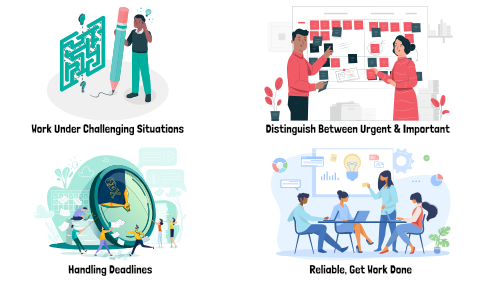
  3. The interviewers are trying to assess whether you can work under challenging situations or unstructured environments and distinguish between the urgent and the important.
  4. They are also looking to see if your coworkers can rely on you to get the work done.

Question 6: Tell me about yourself?

A common question asked by the interviewers at the start of the behavioral interviews is, Tell me about yourself?

Evaluation Criteria

image

  1. This introductory question helps the interviewers in one of their primary goals, which is to get to know you.
  2. Interviewers try to learn various aspects about you from:
    • Your current and past experiences,
    • Your core strengths,
    • Your personality, and
    • Your ability to respond to an unstructured question.
  3. They also notice how well you can connect with your colleagues and communicate your ideas clearly and effectively.

Question 7: Why do you want to leave your current role?

Interviewers often ask the question in behavioral interviews, why are you leaving your current role?

Evaluation Criteria

image

Through this question, the interviewer is trying to understand your intrinsic motivation to check whether you are running away from something or running towards something.

It is an excellent opportunity to demonstrate to the interviewer that you are someone who looks forward with a positive attitude in general.


Question 8: Do you have any questions for me?

The interviewers often asked a critical question towards the end of the behavioral interviews: "Do you have any questions for me?"

Evaluation Criteria

image

This question helps the interviewer to gauge your passion and interest in the current role you are applying for.

It would be best to frame your questions specific to the role and the company you are interviewing for. This will help demonstrate to the interviewer that you have done your homework about their company and culture.

It also gives you an opportunity to end the interview on a strong note.


I hope this article will help in preparing for your upcoming interviews. Best of luck everyone! 🙂

interviewinterview questiononsitebehavioralfacebook
Comments: 6
Anonymous User
Read More

For each question mentioned in this article, learn more about Evaluation Criteria, Response Framework, Tips & Tricks and certain special cases to effectively prepare and answer them in the interview in this video.

Source: This article was originally published on Dev.to

20
Reply
Share
Report
alaska_blues's avatar
Read More

Awesome article! Just want to add a few notes:

  • The coding portion of the interview is optional and it's totally up to the interviewer whether to do it or not, so don't be alarmed if you didn't have it, especially if you're a senior candidate who has a lot to talk about in the behavioral part.
  • When asked about a mistake you made or a weakness you have, don't try to present something that's actually a positive as a negative - this will be a red flag. And never put any blame on the others, even if it's reasonable and objectively true.
  • Stick to the concrete examples from your experience, unless the interviewer explicitly asks about a hypothetical scenario (Google does that, but Facebook usually cares only about your experience).
  • Another very common question (two actually): Tell me about a time you received/gave critical feedback. The giving part is about being constructive with your feedback, helping your coworkers improve, and showing empathy and understanding. The receiving part is about treating constructive criticism as a learning opportunity and taking steps to improve yourself and not make the same mistakes again.

What Does A Google Engineering Manager Do?

May 16, 2021

Here is the link. 

In this video, I sat down with Tom Weingarten, an Engineering Manager at Google, to talk about what Engineering Managers do. We also discussed what he likes about engineering management, what he doesn't like, whether he ever considers going back to software engineering, and what his 20% time project is at Google. Check out the second half of the conversation I had with Tom here: https://youtu.be/QiQiuNhNbtU AlgoExpert: https://www.algoexpert.io/clem SystemsExpert: https://www.systemsexpert.io/clem My LinkedIn: https://www.linkedin.com/in/clementmi... My Instagram: https://www.instagram.com/clement_mih... My Twitter: https://twitter.com/clemmihai Prepping for coding interviews or systems design interviews? Practice with hundreds of video explanations of popular interview questions and a full-fledged coding workspace on AlgoExpert - https://www.algoexpert.io - and use the promo code "clem" for a discount on the platform!

Take my notes:

  1. Leadership from everywhere, not just from manager.
  2. Ownership, product manager, ......
  3. Software engineer vs engineer manager at Google

Melinda Gates | $3 Billion from Cascase wtih Deere Transfer

 May 16, 2021

那么比尔 · 盖茨的财产组合有哪些呢?


据了解,最开始比尔 · 盖茨拥有 44.8% 的微软股份,后来在财富逐渐增长的情况下,他意识到不能过分依赖一只股票,于是开始有步骤地减持微软股票。

同时他开始建立自己的理财团队,1994 年在成立比尔和梅琳达 · 盖茨基金会的时候,Cascade 投资公司也成立了。(对,就是文章开头提到的向梅琳达转移股票的那个投资公司)。

帮比尔 · 盖茨管理 Cascade 的人叫做迈克尔 · 拉尔森,是个职业投资操盘手,此前曾在美国著名基金公司百能投资公司担任债券基金经理一职。

Cascade 管理着庞大的投资组合,通过 Cascade,比尔 · 盖茨拥有价值不菲的资产,包括农业机械制造商迪尔公司 10% 的股权,约 120 亿美元,加拿大国家铁路公司的 110 亿美元,以及帝亚吉欧公司 ( Diageo ) 的 16 亿美元。此外,Cascade 还收购了墨西哥、亚特兰大和休斯顿的四季酒店。

除了投资组合,盖茨夫妇还是美国最大的地主,购置投资了大量房地产。

最负盛名的就是华盛顿麦地那的湖边别墅,它占地面积超过 66000 平方英尺,在华盛顿湖畔拥有大约 500 英尺的私人滨水空间。它拥有 6 个厨房、24 个浴室和 6 个壁炉,配备最先进的技术和设备。2019 年,该房产被评估要收 104 万美元的税,意味着其评估价值为 1.313 亿美元,房产税率为 0.793%。

FAU | USA is slowly back to normal | My renting talk

May 16, 2021

Introduction

I posted the ad in Chinese wechat group FAU, and got two feedback yesterday. I learn through my experience as a home owner. Two possible clients and I learn that USA is slowly back to normal, I felt much better after I had 40 minutes conversation with Dr. Li. 

My experience

I like to learn more things as a home owner in Florida, Boca Raton. I am still too close-minded to learn in Canada, and I have difficulty to build wealth in stock market from March 2019 to May 16, 2021. But I will get better to learn how to deal with anxiety through pandemic. 


As a home owner, I learn so many lessons to work with different tenants. I just paid $6800 dollars for a new roof for the building with 18 units. The monthly maintenance fee went up to $375 US dollars. 


Saturday, May 15, 2021

She's The CEO Of A Fortune 500 Company, And She's Rethinking Leadership | TODAY

May 15, 2021

Here is the link. 

Roz Brewer was recently named CEO of Walgreens Boots Alliance, becoming one of just two Black women leading Fortune 500 companies. She has an innovative approach to leadership, and the bottom line reveals she is good for business. In a TODAY exclusive, Hoda Kotb sat down with her. » Subscribe to TODAY: http://on.today.com/SubscribeToTODAY » Watch the latest from TODAY: http://bit.ly/LatestTODAY About: TODAY brings you the latest headlines and expert tips on money, health and parenting. We wake up every morning to give you and your family all you need to start your day. If it matters to you, it matters to us. We are in the people business. Subscribe to our channel for exclusive TODAY archival footage & our original web series. #CEO #BlackLeaders #Walgreens


Kendall Jenner Opens Up About Her Anxiety | Open Minded | Part 1 | Vogue

May 15, 2021

Here is the link. 

What is social anxiety and how do you cope with it? In the first episode of Open-Minded: Unpacking Anxiety, Kendall Jenner sits down with licensed clinical psychologist and professor of psychology, Dr. Ramani Durvasula, to discuss the symptoms of anxiety she has experienced from a young age. As Kendall opens up about her journey with social anxiety and asks questions from the Vogue community, Dr. Ramani provides tips and tricks for handling social anxiety and re-entering social situations post covid. For more information on anxiety symptoms, treatment, and resources please visit: http://nami.org/anxiety For more on Dr. Ramani’s interview with Kendall watch her video at:https://www.youtube.com/watch?v=-Vri5... and check out her YouTube channel: https://www.youtube.com/user/DoctorRa... If you or someone you know is struggling, you are not alone. Connect with the NAMI HelpLine Mon-Fri, 10AM – 8PM (ET) by calling 800-950-6264 or CHAT at http://www.nami.org/help. In a crisis? Text “NAMI” to 741741, 24/7. Special Thanks To Derek Blasberg Maya Amolis Dr. Ramani Durvasula Ashleah Gonzales Christy Welder Jessica Edwards Barb Solish Katrina Gay Dr. Ken Duckworth YouTube Health Medcircle NAMI The National Alliance on Mental Illness, is the nation's largest grassroots mental health organization dedicated to building better lives for the millions of Americans affected by mental illness. Directed by: Posy Dixon DP: Kevin Hayden Camera Operators: Yuya Kudo, Zachary Rockwood and Sonja Tsypin Key Grip/Gaffer: Kurtis Myers Sound: Chris Omae Edited by: Victoria Mortati and Daniel Poler Color: Carlos Flores, Forager Sound: Paul Vitolins and Nick Cipriano, Bang Post Production: Marco Glinbizzi Series Title Montage: Chris Beckman Title Design: Jason Duzansky Visual and Audio Design: Natalia Stuyk Art Director, Set Design: Alexis Johnson Decorator: Christine DiStefano Styling: Danielle Levi Hair: Amanda Capomaccio Makeup: Mary Phillips Tailor: Bebe Aguirre Executive Producer: Marina Cukeric Producers: Naomi Nishi, NY and Jace Davis, LA Line Producers: Jen Santos and Jessica Schier Production Manager: Trina DeMattei Location Manager: Joe Burk Production Coordinators: Peter Brunette and Andressa Pelachi Associate Producers: Rachel Cantor, Stephanie D’agostini and Arielle Neblett Production Assistant: Josh Crowe Covid Supervisor: Carla Nora Vogue: Robert Semmer, VP Digital Video Programming and Development; Mark Guiducci, Creative Editorial Director; Sergio Kletnoy, Entertainment Director. Still haven’t subscribed to Vogue on YouTube? ►► http://bit.ly/vogueyoutubesub Want to hear more from our editors? Subscribe to the magazine ►► http://bit.ly/2wXh1VW Check out our new podcast 'In Vogue: The 1990s' ►► https://link.chtbl.com/iv-yt-description

NOK stock: Ford equity research | May 15 2021 | Undervalued

Recommendation Summary

Ford's Hold recommendation on Nokia Corp. is the result of our systematic analysis on three basic characteristics: earnings strength, relative valuation, and recent stock price movement. The company has generated a negative trend in earnings per share over the past 5 quarters and while recent estimates for the company have been raised by analysts, NOK has posted better than expected results. Based on operating earnings yield, the company is undervalued when compared to all of the companies we cover. Share price changes over the past year indicates that NOK will perform very poorly over the near term.

Earnings Strength is NEGATIVE

Ford's earnings momentum measures the acceleration or deceleration in trailing 12 month operating earnings per share growth. The downward curvature of the plotted points in the graph on the right indicates that while Nokia Corp.'s earnings have increased from $0.25 to an estimated $0.36 over the past 5 quarters, they have shown deceleration in quarterly growth rates when adjusted for the volatility of earnings. This is an indication of weakness that could lead to declining earnings.

Nearly 40 years of research have shown that the change in the growth of earnings per share is an important factor that drives stock price performance. Ford measures earnings momentum and analysts' forecast changes to get an early indication of changing earnings patterns.

Recent changes to analysts’ forecasts and variances between reported and estimated earnings provide important information about a company’s future earnings performance. Ford uses this information, in conjunction with earnings momentum, as early evidence of a catalyst to near-term stock price performance. Earnings forecasts for Nokia Corp. have been increasing which indicates an improvement in future earnings growth. The company has also reported higher earnings than those predicted in earlier estimates. This indicates an ability to exceed analysts’ expectations and the potential for improving earnings growth in the future.

Relative Valuation is POSITIVE

Nokia Corp.'s operating earnings yield of 7.3% ranks above 79% of the other companies in the Ford universe of stocks, indicating that it is undervalued. Ford measures the relative valuation of each company against all other companies in our research universe. Operating earnings yield, an earnings-to-price ratio based on the last 3 quarters of operating earnings and the current quarter's estimate, has proven to be the most reliable relative valuation measure. A stock may stay undervalued or overvalued for a long period of time. For this reason, it is important to combine this factor with shorter-term predictive factors such as earnings momentum or price momentum to identify more imminent valuation adjustments.

Price Movement is VERY NEGATIVE

Nokia Corp.'s stock price is up 43.3% in the last 12 months, up 17.5% in the past quarter and up 18.6% in the past month. This historical performance should lead to below average price performance in the next one to three months.

Historical price action of a company's stock is an especially helpful measure used to identify intermediate and short term performance potential. Long term historical performance is a good predictor of future price performance, but much more importantly, large price movements over the intermediate and short term tend to reverse themselves. Ford's price momentum measure integrates historical long, intermediate and short term price changes, creating ratings that are highest for stocks with strong twelve month price performance that have had a price consolidation in the past quarter and month.

NOK stock: May 15, 2021 | Stock report | Equity analyst June Zhang Tan, CFA

May 15, 2021

Introduction

I am trying to do my best to work on Nokia equity research. I like to learn better by reading equity report. It takes time for me to figure out how to be a smart equity investor as a value investor. I do think that I chose three stocks: GTE, GRAY, NOK to invest more than $10,000 dollar capital, and I like to keep learning and see what I should do better next time. 

 COMPANY BACKGROUND: 

Founded initially as a pulp mill in 1865, Nokia has undergone various business transformations throughout its history, but it was best-known for the mobile phone business, which formed its mainstay throughout 1990s to 2013. However, following the sale of its mobile phone business to Microsoft in 2014, Nokia is now predominantly focused on the telecom infrastructure market. In 2016, Nokia acquired Alcatel-Lucent, strengthening its position as a leading player in the telecom infrastructure market. The company is headquartered in Finland, while its shares are listed on the Helsinki Stock Exchange, New York Stock Exchange, and Paris Stock Exchange. It is one of the major constituents of the OMX Helsinki 25 Index.

DIVISIONAL OVERVIEW: Nokia has three reportable segments -- Networks, Nokia Software, and Nokia Technologies. Networks is the core business segment that accounted for 77% of 2020 total revenue, followed by Nokia Software’s 12% and Nokia Technologies’ 6.4%.

The Networks segment comprises the Mobile Networks, Global Services, Fixed Networks, and IP/Optical Networks Operating segments. Mobile Networks is the key segment that focuses on mobile radio, including macro radio base stations, small cells, and cloud-based radio. Global Services covers services such as network planning and optimization, network implementation, system integration, as well as company-wide managed services. Fixed Networks provides copper and fiber access products, solutions, and services.

Lastly, IP/Optical Networks provides IP routing, packet core, and optical transport systems.

Nokia Software encompasses software solutions and consulting services for customers in the area of customer experience management, network operations, communication, policy & charging, analytics, security, cloud, and Internet of Things. On the other hand, Nokia Technologies (7% of 2018 sales) primarily deals with its intellectual property rights licensing activities.

MARKET COMPETITION: In terms of sales by region, North America contributed 33% in 2020, followed by 30% in Europe and 18% in Asia-Pacific. The remaining came from Greater China, Latin America, and Middle East & Africa. Conditions in the market for mobile and fixed network infrastructure and related services remain competitive and challenging. In 2019, Nokia’s 4G+5G market share was in the range of 27%, excluding China.

In 2020, the market share remained stable at 27%-28%. Despite the ban on Huawei’s 5G equipment from several nations due to national security concerns, it seems that Nokia has not been able to gain much share outside of Europe. Although China is the pioneer in the 5G race that accounts for the majority of 5G spending growth, Nokia’s market share is losing to Chinese vendors and Ericsson due to its strategic reason to exit the unprofitable market. As a result, its revenue from Greater China declined 9% in 2020. Going forward, the market competition remains intense even though we are in the early phase of the 5G investment cycle. For 2021, Nokia expects its market share, excluding China, to be impacted in 2021, primarily due to not converting its 4G footprint into 5G footprint in North America. Therefore, Nokia expects a dip in its market share to 25%-27% in 2021.

CORPORATE STRATEGY: In spite of the challenging industry environment, Nokia will continue to invest in sustaining its network leadership, such as in 5G, while it looks to expand into adjacent markets with higher growth rate, such as in Webscale and selected vertical markets. It also intends to build a strong standalone software business, which we think is in response to the rising adoption of Software-Defined Networking and Network Function Virtualization technology.

FINANCIAL TREND: In 2020, Nokia’s total net sales declined 4% to EUR21.867 billion due to lower network deployment and planning services in Mobile Access. In terms of region sales performance, North America was up 5%, driven by 5G deployment and Europe was up 1% due to market share gains from Huawei.

However, Nokia’s sales declined in Greater China (-25% due to market share loss), Asia-Pacific (-13% due to declining 4G sales and negative impact of Covid-19), and Latin America (-24% due to similar reasons as Asia-Pacific). Non-IFRS gross margin improved 2.5%-pts to 39%, thanks to a strong 5G gross margin driven by higher ReefShark shipment volumes. As the operating expenses were broadly stable, this led to a 1.1%-pts improvement in EBIT margin to 9.7% in 2020. The shipment of “5G powered ReefShark” portfolio increased 43% by the end of 2020, which was above its 35% target. Nokia remains focused on achieving 70% by the end of 2021 and 100% by the end of 2022, helping to improve the 5G gross margin.

Nevertheless, Nokia expects the 2021 EBIT margin to be 7%-10% due to the challenging outlook in North America and ongoing R&D investments.

My NOK stock position


Friday, May 14, 2021

Walking research: 12 miles per week | cardiovascular health

May 14, 2021

Here is the article written in 2005. 

People only need to walk up to 12 miles per week or for about 125 to 200 minutes per week to improve their heart health

The amount of exercise may be more important than intensity to improve cardiovascular health, according to a new analysis of the first randomized clinical trial evaluating the effects of exercise amount and intensity in sedentary overweight men and women.

This finding of the value of moderate exercise should be encouraging news for those who mistakenly believe only intense exercise can improve health, said the researchers who conducted the trial.

The trial, led by researchers at Duke University Medical Center, found that a moderate exercise regimen, such as 12 miles of brisk walking each week, can provide significant improvements in fitness levels while reducing the risks of developing cardiovascular disease. Furthermore, the researchers found that any additional increase in amount or intensity can yield even more health benefits.

The results of the analysis were published in the October, 2005, issue of the journal Chest.

"People only need to walk up to 12 miles per week or for about 125 to 200 minutes per week to improve their heart health," said the lead author Brian Duscha. "Our data suggest that if you walk briskly for 12 miles per week you will significantly increase your cardiovascular fitness levels compared to baseline. If you increase either your mileage or intensity, by going up an incline or jogging, you will achieve even greater gains."

The researchers said that their findings should inspire those couch potatoes who have been hesitant to begin exercising regularly -- especially since earlier analysis of the same participants (will insert link to inactivity study) by the same Duke team found that people who do not exercise and maintain the same diet will gain up to four pounds each year.

"The participants in our study received the fitness benefits without losing any weight," Duscha said. "Many people exercise to lose weight, and when that doesn't occur, they stop exercising. However, the truth is that you can improve cardiovascular fitness and reduce the risk of heart disease by exercising without losing weight."

To better understand the effects of differing amounts of exercise, the researchers studied 133 overweight sedentary men and women who were beginning to show signs of blood lipid levels high enough to affect their health. They were randomized into one of four groups: no exercise, low amount/moderate intensity (equivalent of 12 miles of walking per week), low amount/vigorous intensity (12 miles of jogging per week) or high amount/vigorous intensity (20 miles of jogging per week).

Since the trial was designed solely to better understand the role of exercise, patients were told not to alter their diet during the course of the trial, which lasted six months for the group that did not exercise or eight-months for the exercise groups. The additional two months for the exercise group came at the beginning of trial, when participants slowly ramped up their exercise to their designated levels. The exercise was carried out on treadmills.

For their analysis, the team compared two measurements of fitness – peak VO2 and time to exhaustion (TTE) – before and after the trial. Peak VO2 is a calculation that measures the maximum amount of oxygen that can be delivered by circulating blood to tissues in a given period of time while exercising.

While all the exercise groups saw improvements in peak VO2 and TTE after completing their exercise regimens, the researchers noticed some interesting trends.

"We found that when we compared the low amount/moderate intensity group to the low amount/vigorous intensity group, we did not see a significant improvement in peak oxygen consumption," Duscha said. "However, when we increased the amount of exercise from 12 to 20 miles – at the same intensity – we did see an improvement in peak oxygen consumption."

Also, although no statistically significant difference was detected between the low amount/moderate intensity group and the low amount/high intensity group, the researchers did see a trend toward both a separate and combined effect of exercise intensity and amount on increased peak VO2 levels.

The Duke team was led by cardiologist William Kraus, M.D., who received a $4.3 million grant from the National Heart, Lung and Blood Institute in 1998 to investigate the effects of exercise on sedentary overweight adults at risk for developing heart disease and/or diabetes. The results of that five-year trial, known as STRRIDE (Studies of Targeted Risk Reduction Interventions through Defined Exercise), and other analyses of the data collected, began to be published in 2002.

The Duke team is currently enrolling patients in STRRIDE II, in which researchers are seeking to determine the effects of weight training, alone and in combination with aerobic training, on cardiovascular health.

Joining Duscha were Duke colleagues Cris Slentz, Ph.D., Johanna Johnson, Daniel Bensimhon, M.D., and Kenneth Knetzger. Joseph Houmard, Ph.D., East Carolina University, was also a member of the team.