Reverse Engineering: Understanding the ‘Why’ to Achieve Trading Consistency
Wisdom from Marios Stamatoudis

Last week’s stack revolved around three ‘golden’ rules:
Always sell some into strength.
You can’t outsmart the 10- and 20-day moving averages.
If your stop is hit, just sell.
And I closed with:
“Even though I was already familiar with [Jeff Sun’s] content, putting this stack together taught me (again) that there’s a world of difference between consuming and studying content.
“I certainly have a new appreciation for the nuances of profit-taking. Balancing the need to stay in big winners while not giving back too much unrealised profit is something I need to improve as a trader.
“Deepening my understanding of a system such as Jeff’s — not just the how, but the why — will only help with that.”
Why did I say that?
Because I’ve definitely been guilty of selling full positions too early.
Why? Due to a combination of:
Insufficient trust in the moving averages
Not fully understanding the benefits of selling partials
In fact, my notes on Qullamaggie’s Chat With Traders interview, written in July 2023 (1½ months after starting this Substack), demonstrate this lack of understanding — or, as I like to think of it now, document my growth as a trader since then.
It’s not that I said anything technically incorrect.
But read it back through today’s lens, and it becomes obvious how I had no in-depth understanding of Kristjan’s sell rules.
I wasn’t digging deep enough into why selling partials while trailing the rest was so important.
Being told about the ‘why’ wasn’t enough for things to really click.
Likewise, just reading the tweet by Jeff that was the main inspiration for last week wasn’t enough for the ‘why’ to truly sink in.
In fact, a reader left a comment making a similar remark: they’d actually bookmarked that tweet, and yet…
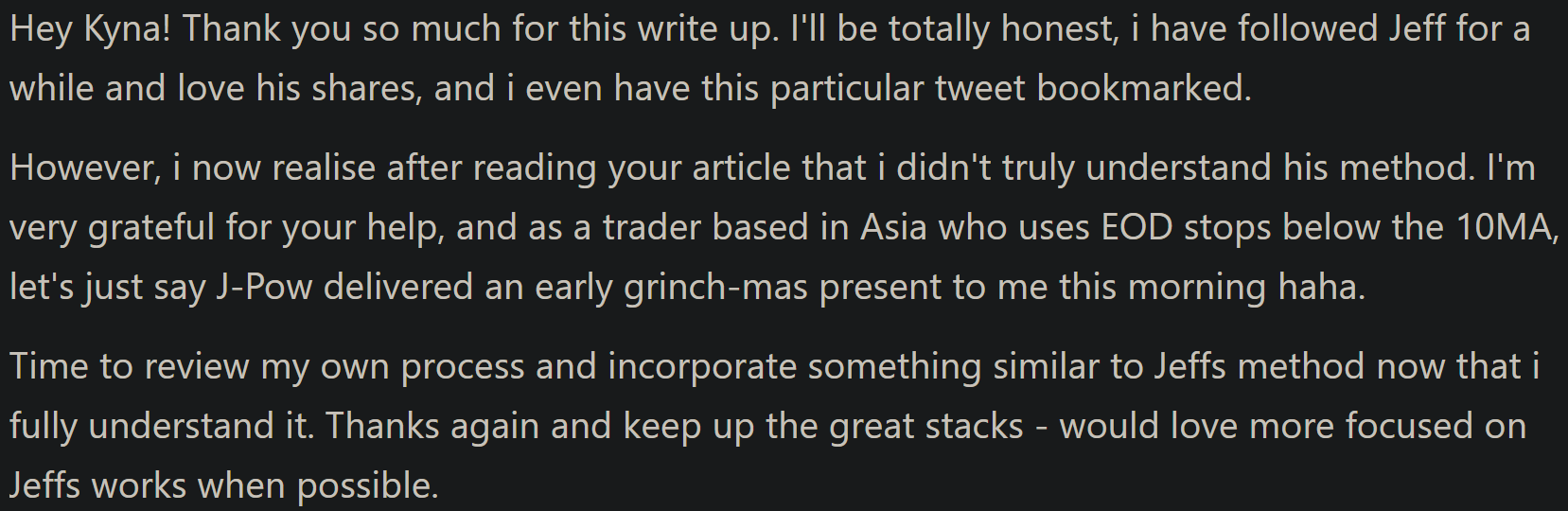
This resonates.
Admittedly, my problem was profit-taking rather than stop losses, but no matter your challenge, it takes practical experience, combined with studying both the ‘how’ and the ‘why’, for an effective system to truly click.
Even then, you’ll keep on learning and, where necessary, tweak your system.
But where does this type of thinking fit into the bigger picture?
Marios Stamatoudis offers some big-picture wisdom.
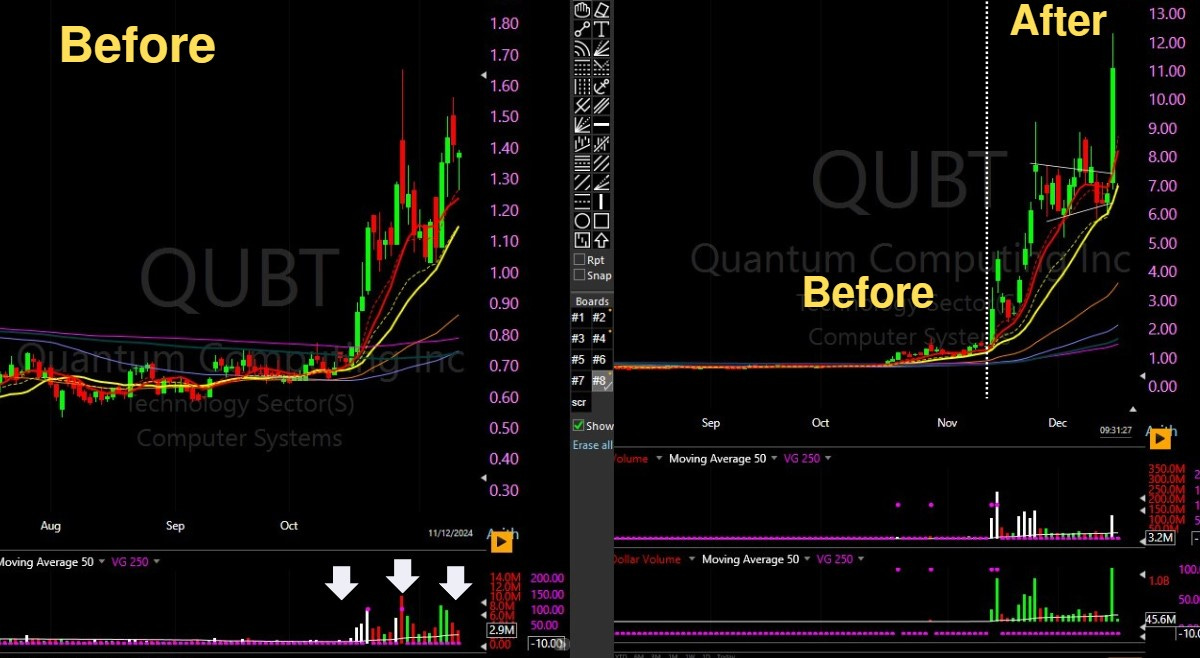
Lots of gems to choose from, but let’s use this tweet as a starting point.
I like how Marios clearly outlines what you must deeply, truly accept:
Big moves take many days or weeks (if not longer!) to unfold.
You have no way of knowing a stock’s potential.
He therefore doesn’t monitor each individual candlestick — because this only adds pressure, making you more prone to emotional decisions.
In Marios’s words:
“It was a commitment to simplicity and respecting the market’s randomness by making it an ally of mine.
“I threw the ball to the market and the stocks to show me if they are worth it, rather than deciding for myself.”
He settled on a method popular among great traders:
Reward yourself for your efforts: sell into strength.
Protect your downside: move your stop to breakeven.
Let randomness work for you: trail the moving averages.
You also want to put yourself in a position where, as Marios says, asymmetry is more likely to emerge:
“The characteristics present themselves in the same way, year after year after year. […]
“It’s like the price foretells the story of probable events.”
What about consistency?
‘Consistency’ is a term you hear a lot in trading.
For that matter, you hear it in lots of high-performance fields. An outlier is great, but of limited value if you can’t repeat the performance. How can you consistently perform well? How can you continually improve?
Ultimately, outputs are outside our control.
But inputs aren’t.
Consistent inputs may not guarantee consistent outputs, but are a prerequisite for achieving consistency.
For a writer, that might mean writing a weekly newsletter, for example. Or spending at least two uninterrupted hours a day writing. Or writing at least 1,000 words a day.
For traders, it’s having a defined process/system and consistently following it.
The more consistent your efforts (in terms of both focus and showing up), and the longer your time horizon, the better your outputs.
The time horizon aspect is key — particularly in trading. To quote Marios:
“Consistency is not just about having only positive monthly gains and triple digit years.
“Consistency, for me, is receiving feedback around the average of your established goals and continuing to operate in the same way to create a pattern of similar feedback in the long run.”
How long is “the long run”?
Jeff offers some perspective:
“Don’t fixate on the performance of your last 10 trades, the performance this week or this month — focus on the performance of your last 500 trades. Embrace the big picture, the law of large numbers, and a long-term perspective in trading.”
Coming back to Marios, he outlined three elements required for consistency in trading — all of which require significant time and effort.
Paraphrased, these are:
An efficient and complete system
Complete trust in each component within that system
Full understanding (and acceptance) of your system’s expectancy
(Marios’s tweet explains the challenge of each for traders.)
You need each element to become proficient at handling uncomfortable (but normal) aspects of swing trading like:
Being in a drawdown most of the time
Facing more bad than good days
Consecutive losing streaks
And we haven’t even touched on the discomfort of trying to follow rules like trailing MAs, only to give back much of our profits — potentially for many trades in a row!
Remember: these types of rules only work over large enough numbers, and both successful and unsuccessful trades will be ‘batched’.
How can you trust such rules if you can’t see their effectiveness most of the time?
Marios gives us the answer: reverse engineering.
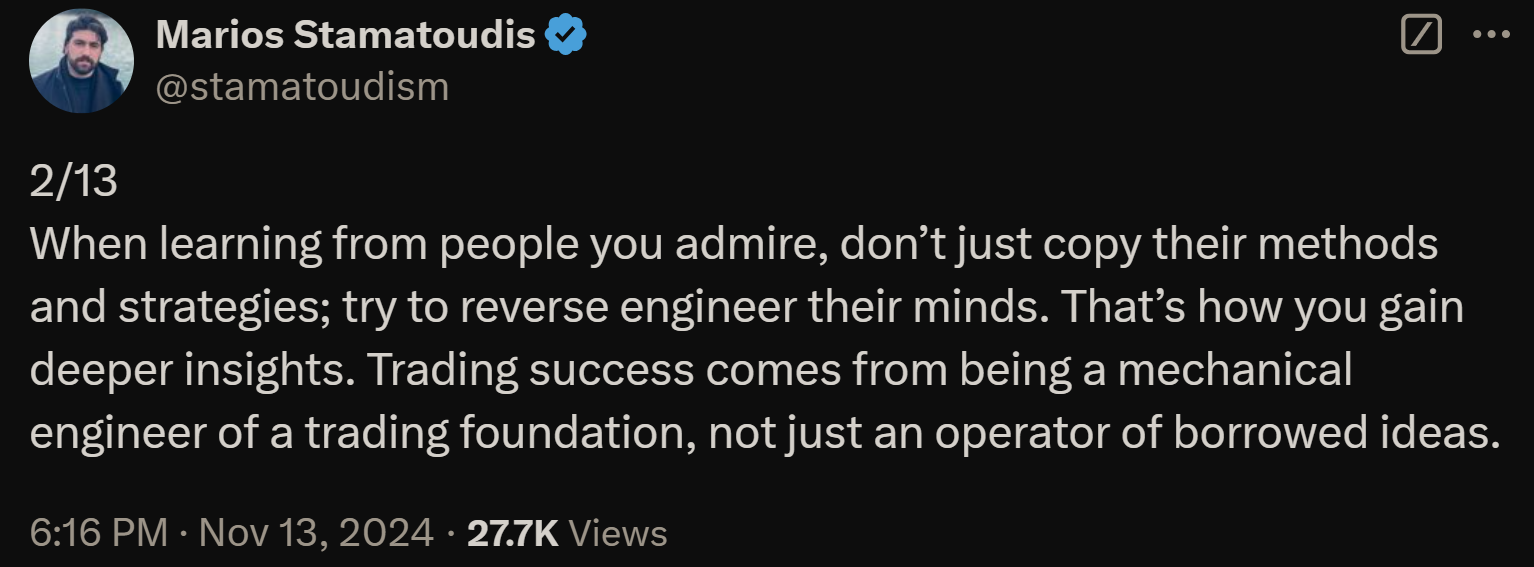
And in a different tweet:
“Trading efficiency is often just a few adjustments away.
“These adjustments typically arise from spontaneous ideas that come after deep reflection and long-term obsession with the markets. […]
“Most of us, when starting out, only know how to operate systems handed to us by others. But the true differentiator of successful traders is this:
“An Operator sees complexity, while a Mechanical Engineer understands the system inside out and can optimize and refine the trading engine for success.”
One challenge, as Marios points out, is a lack of time (particularly as a part-time trader).
I’d add a second problem: many people have trained themselves to go for easy rewards — like scrolling social media — when they’re bored (something I’ve previously discussed).
If you put yourself in a position where you literally can’t focus your mind on the same problem for even half an hour, you severely limit the quality and depth of your thinking.
And distraction is the enemy to depth.
But if you can get comfortable with being alone with your thoughts, you’ll think more clearly. In turn, that enables you to solve more complex problems and to innovate.
You can come up with the refinements that can give you that vital breakthrough.
Whether in trading or elsewhere.
Reflection
Marios’s tweets always make me reflect on trading.
(And occasionally on life, too.)
As we near the end of the year, and I near the end of my employment and the start of something new, this seemed like a good time for a stack like this: a combination of self-reflection and some content inspired by Marios.
Many of today’s topics I’ve discussed previously on The Trading Resource Hub — sell rules, reverse engineering, consistency, processes, and more.
But when I read back my old posts, it’s obvious how my understanding has deepened with time, practice and reflection. Part of this growth comes from more trading experience.
Another part comes from my approach to this Substack.
Last week, I was asked (again) about my writing process. And yes, I’ll write an article about it (not on this Substack) when I’m able. If you have questions for me, please leave a comment or hit reply, and I’ll address them in this future article.
But to keep it short today…
For my day job and client work, I take an extremely structured approach. Ditto for a chunk of my stacks.
Other stacks, like this one, I write as I think. It makes for a time-consuming process that requires way more editing than my norm. The punishment for not building my ‘skeleton’ first.
But this reflective approach allows me to think more deeply, and make connections or notice details I’d have otherwise missed. It’s become a crucial part of my studies. And I’m a better trader and, I hope, thinker for it.
‘Study, write, publish’ remains my favourite triad. I encourage everyone to try it.
And if you want me to review your published writing and give feedback, shoot me a message.
Have a wonderful Christmas!
Kyna

No comments:
Post a Comment